OrangeHRM has released App Builder, a no-code module that lets administrators design custom applications, forms, approval workflows, permissions, and generated documents for HR processes that don't fit neatly into an existing module. The release addresses a problem nearly every HR team quietly lives with: the process is too specific for standard HR software, and too sensitive to keep living in a spreadsheet.
The timing tracks a broader shift already underway across HR functions. Roughly 41 percent of enterprise employees have already built at least one application using no-code or low-code tools, and operations managers, the same functional profile as most HR administrators, make up the single largest group of citizen developers. App Builder brings that capability directly into the HRMS, rather than asking HR teams to adopt a separate, disconnected platform.
The Gap App Builder Was Built to Close
Every HRMS is designed around the processes most organizations share: leave, time tracking, performance reviews. That shared foundation is exactly why it tends to fall short on the remaining slice of work, the process unique to one company, one region, or one department. A regional leave variant with different documentation rules. An internal grievance intake that needs strict confidentiality. An equipment request approval chain nobody thought to formalize.
Historically, teams facing that gap had two options, and both carried real costs. The first was a spreadsheet, fast to stand up but lacking any audit trail, field-level permission control, or automatic notifications, a pattern documented well beyond HR. Shadow spreadsheets tend to start innocently, as a quick fix when existing systems can't do what a team needs, and often become mission-critical files that only one person fully understands. The second option was a formal development request, which solved the audit-trail problem but competed for the same engineering time as every other project on the roadmap, usually losing.
App Builder is designed to remove that choice entirely by letting the people who understand the process build it themselves, inside the same system that already holds the employee data it depends on.
What's Included in This Release
App Builder ships with five core components that together form a complete custom application, without requiring a developer at any stage.
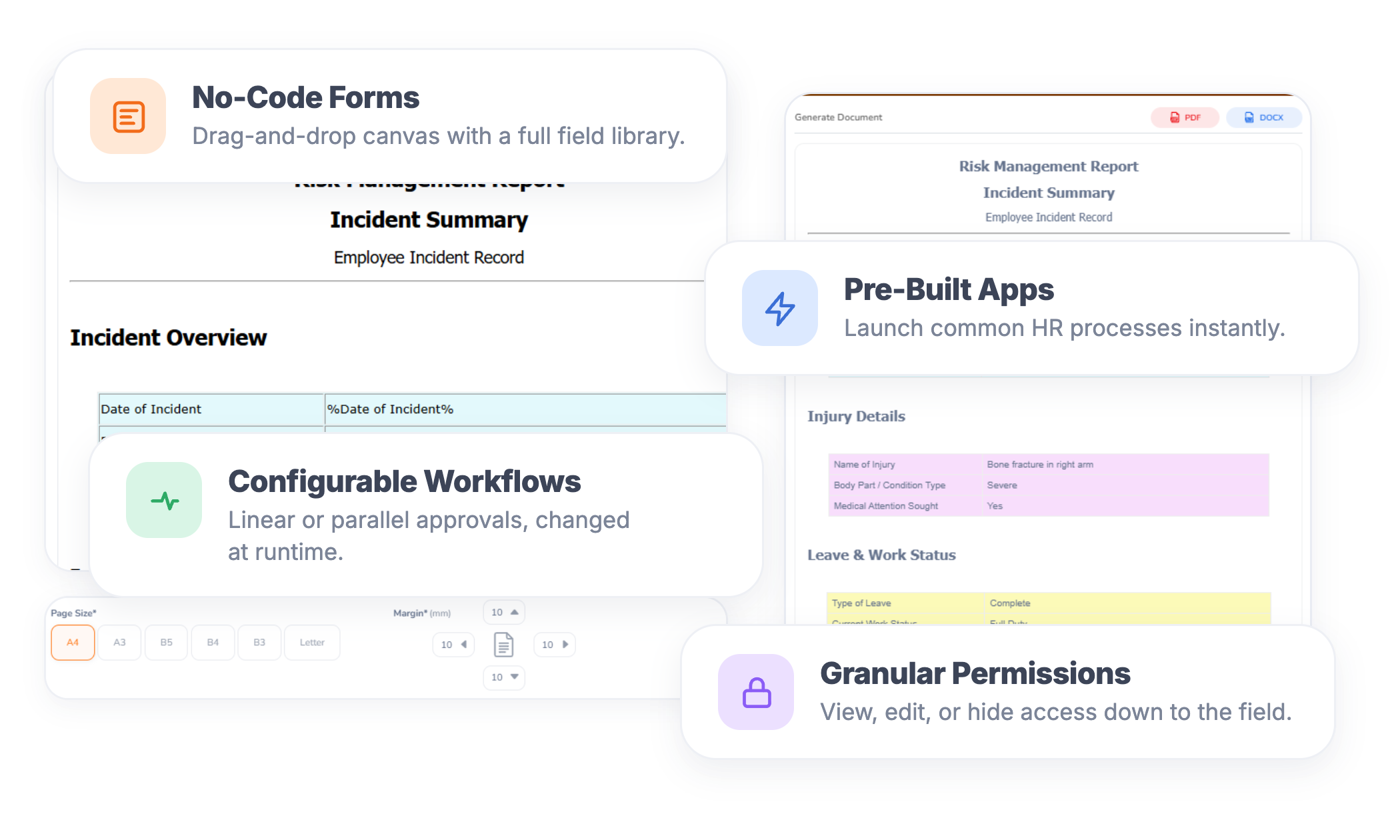
No-Code Forms - A drag-and-drop canvas lets administrators build screens using a full library of field types, text fields, dropdowns, date pickers, file attachments, employee autocomplete lookups, and more. Each field can be set as mandatory, read-only, or conditionally shown based on an earlier answer, and forms can be previewed before publishing.
Configurable Workflows - Every application includes a workflow builder supporting linear or parallel approvals, routing by organizational hierarchy, or routing to a specific employee named on the form itself. Records can loop back for correction or move forward differently depending on the outcome of each action, and workflows can be adjusted even while records are already in progress.
Granular Permissions - Access can be defined down to the individual field, not just the form as a whole, a distinction that matters for anything involving confidential HR data. Each user role can be set to Read-Only, Editable, or Hidden at every stage of the workflow, and the ability to build applications at all can itself be delegated to trained Custom Administrators rather than left solely to System or Global Admins.
Automated Notifications - Emails trigger automatically on submission, approval, rejection, return, or completion, with subject lines and content populated from the record's own data using token substitution. Reminder notifications can also be scheduled against a due date, so pending approvals don't stall silently.
Document Generation - Completed records can generate a finished PDF or Word document automatically, an offer letter, a certificate, a formal notice, populated from the data already captured, removing the manual step of copying fields into a template.
App Builder turns a form into a governed application by connecting it to a workflow, locking it down with field-level permissions, backing it with automatic notifications, and letting it generate a finished document, all without writing code.
Where This Shows Up in Day-to-Day HR Work
A few scenarios illustrate what becomes possible with this release:
-
Succession Planning - An organization can build processes to replace Excel-based succession planning with a structured nomination to approval workflow. This also comes with specific views, email notifications, document generation for sign-off.
-
Internal Travel & Expense Tracking - Deploy workflows to track and approve travel claims made by employees with a full list view for HR to access compliance and transparency.
-
One-Off Approval Chains - Equipment requests or expense exceptions can run through an auditable, notification-backed approval flow instead of an email thread with no record of who approved what.
-
Managed Reference Data - Course codes, certification types, or vendor lists can live in a dedicated Master Data form that other applications reference through a lookup field, so updating the list in one place updates it everywhere it's used.
Built With Governance in Mind
Momentum around citizen-built tools tends to outpace planning for who maintains them, and that risk is well documented rather than theoretical. A 2024 Gartner survey found that 43 percent of citizen developer initiatives launched in the prior three years had been scaled back, paused, or shut down, typically once the original builder moved on and nobody else owned the result.
App Builder addresses this directly by keeping build access a permissioned capability rather than an open one. Application-level access can be granted specifically to Custom Administrators through data group permissions, so organizations can decide exactly who is allowed to create, edit, publish, or delete applications, keeping the benefit of speed without recreating an ungoverned sprawl of tools.
How It Fits Into the Existing HRMS
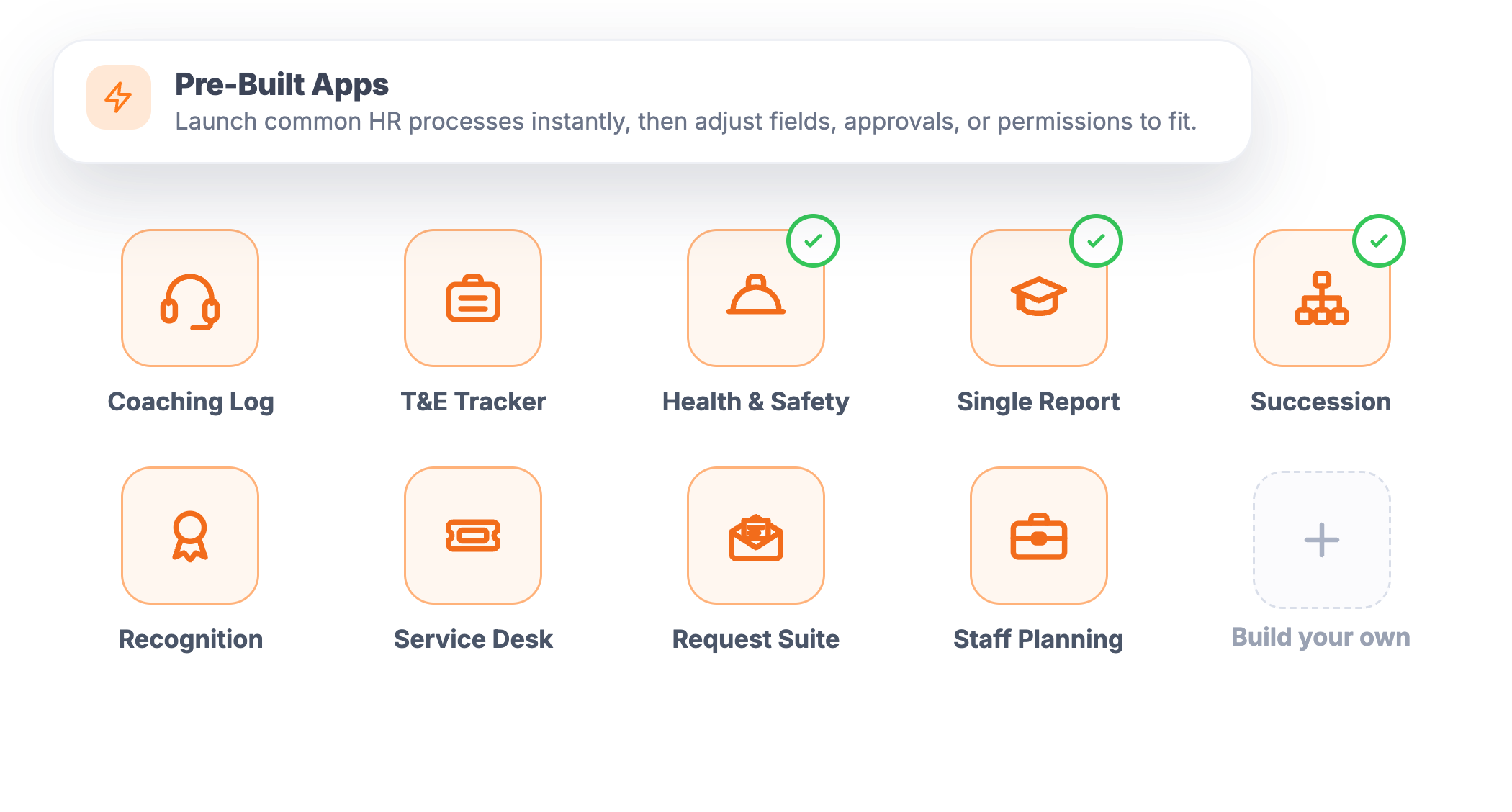
Rather than functioning as a bolt-on tool, App Builder is built directly into OrangeHRM's existing HR software, so custom applications reference the same employee records and system master data, job titles, locations, sub-units, already in use across every other module. An application built with App Builder appears in the sidebar once published, and its records can be included in Reports & Analytics under the standard Employee Management report type, alongside the CSV, Excel, and PDF export options already familiar to HR teams.
A single App Builder license covers unlimited bespoke applications, prebuilt customizable templates, so there's no per-app fee or additional licensing step as more processes are built out over time.
Explore how administrators are already using App Builder to close the gap between what standard HR software covers and what their organization actually needs, no development backlog required. Book your FREE demo today!