Most HR professionals have tried an AI tool at least once. A smaller number use it consistently. An even smaller group uses it in a way that actually saves meaningful time. The difference? Not the tool, the prompt.
AI is only as useful as the instructions you give it. A vague prompt produces a vague result. A well-structured prompt, tailored to the specific HR task at hand, produces output that is usable, contextually relevant, and genuinely faster than doing the work manually. This is the core principle behind effective AI prompt engineering for HR teams.
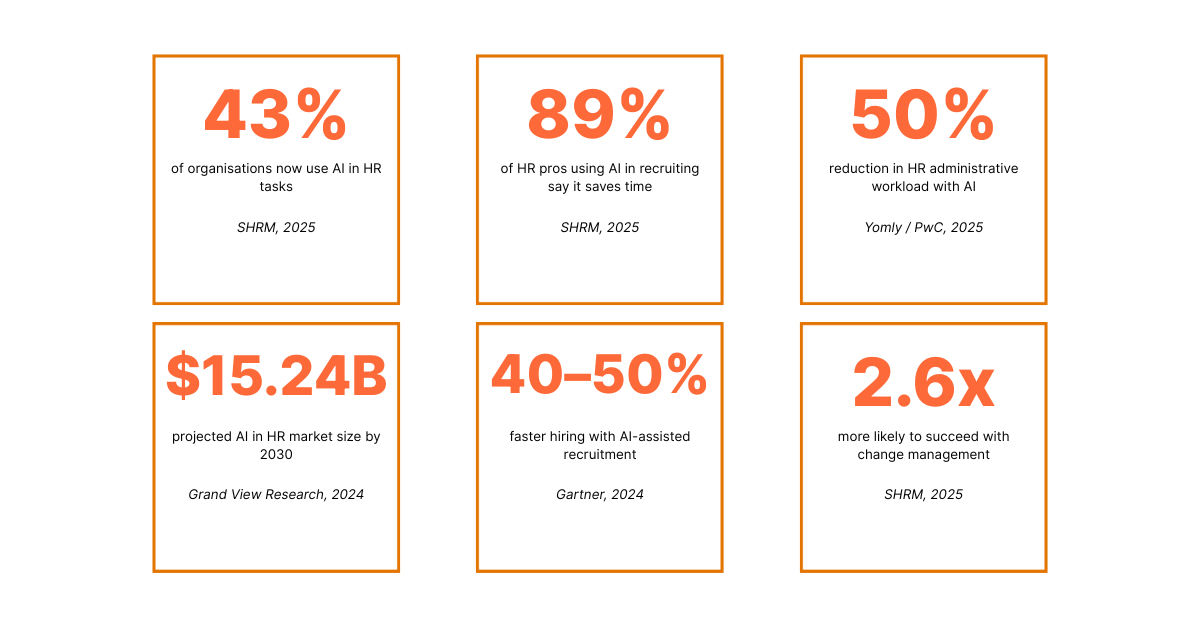
According to SHRM’s 2025 Talent Trends research, 43% of organizations now leverage AI in HR tasks, up sharply from 26% in 2024. Yet adoption alone does not translate to results. The same research found that only 17% of HR professionals describe their organisation’s AI implementation as “highly successful.” The gap between using AI and using it well is significant, and it starts with knowing what to ask.
This guide is designed for HR professionals who want to move beyond basic AI use and build a practical library of high-quality prompts across the most common HR workflows: recruiting, onboarding, policy writing, employee communications, performance management, and learning and development. Each section includes ready-to-use prompt frameworks, guidance on how to customise them, and notes on where AI adds the most value and where human judgment must take over.
Why AI Prompts Matter More Than the Tool
The AI in HR market was valued at USD 3.25 billion in 2023 and is projected to reach USD 15.24 billion by 2030, growing at a compound annual rate of 24.8% (Grand View Research, 2024). This growth reflects the breadth of HR functions now within AI’s reach: talent acquisition, workforce planning, employee engagement, compliance monitoring, and learning and development.
Yet the technology itself is only one piece of the puzzle. A large language model (LLM), the underlying engine powering most AI writing and analysis tools, responds to instructions. The quality of its output is directly proportional to the clarity, context, and structure of the prompt it receives. Prompt engineering, the practice of crafting precise, effective instructions for AI, has therefore become a foundational skill for modern HR teams.
Consider two HR teams facing the same task: drafting a job advertisement for a senior operations role. The first team types a simple instruction and accepts the generic output as-is. The second team structures a detailed prompt that specifies the industry, seniority level, desired candidate profile, tone of voice, and any inclusion considerations. The second team’s output requires minimal editing; the first team’s output requires a complete rewrite. Same tool. Dramatically different outcomes.
SHRM’s 2025 research reinforces this point: among HR professionals already using AI in recruitment, 89% report that it saves time or increases efficiency. Recruiting currently leads all HR use cases, with 66% of AI-using HR teams applying it to generate job descriptions and 44% using it to screen resumes (SHRM, 2025). The prompt quality driving those results varies significantly, which is why a structured prompt library is a competitive advantage, not just a productivity convenience.
What Makes a Strong HR Prompt?
A well-designed HR prompt typically contains four components:
|
Prompt Component |
Purpose |
Example |
|
Role / Persona |
Tells the AI who it is speaking as or for |
"Act as a senior HR business partner with experience in manufacturing..." |
|
Task |
Clearly states what needs to be produced |
"...write a job advertisement for a Production Supervisor role..." |
|
Context |
Provides relevant constraints and background |
"...for a 600-person facility in a unionised environment, targeting candidates with 5+ years of floor management experience." |
|
Output Format |
Specifies structure, length, tone |
"...Use a professional but direct tone. Include three key responsibilities and two must-have qualifications. Maximum 300 words." |
Source: OrangeHRM,2026
When these four elements are combined, the AI has enough context to produce relevant output, on-brand, and requires minimal editing. When any element is missing, the output tends to be generic or off-target.
AI Prompts for Recruiting and Talent Acquisition
Recruiting is the most widely adopted AI use case in HR, and for good reason. The administrative burden of talent acquisition is significant: writing job descriptions, screening applications, preparing interview questions, and communicating with candidates all consume hours that HR teams rarely have in surplus. AI, when prompted well, can dramatically compress this timeline.
Research from Gartner (2024) indicates that AI-assisted recruitment tools reduce time-to-hire by 40 to 50%. For a growing organisation hiring 20 to 30 roles per quarter, that efficiency gain translates directly into competitive advantage: roles filled faster, revenue-generating headcount onboarded sooner, and HR bandwidth redirected toward strategic work.
Writing Job Descriptions
Imagine an HR team at a mid-sized logistics company preparing to hire across six departments simultaneously. Writing individual job descriptions from scratch would take several days. With a strong AI prompt, the same team can generate a first-draft JD in under three minutes, then spend 15 minutes reviewing and refining it, a fraction of the original effort.
PROMPT TEMPLATE: Job Description
You are an experienced HR business partner. Write a professional job description for a [JOB TITLE] role at a [INDUSTRY] company with [COMPANY SIZE] employees. The role reports to [REPORTING LINE] and is based [LOCATION/REMOTE STATUS]. Key responsibilities include [2-3 MAIN DUTIES]. Required qualifications: [MUST-HAVES]. Preferred qualifications: [NICE-TO-HAVES]. Tone: [professional/approachable/technical]. Length: 300-400 words. Include an equal opportunity statement at the end.
Tip - For roles requiring specific technical expertise, add a line such as: “Highlight the importance of [specific certification or skill] and frame the role as a growth opportunity for candidates at the mid-career level.” This level of specificity significantly improves the relevance of the output.
Where OrangeHRM Fits - OrangeHRM’s recruitment module allows HR teams to store, post, and manage job descriptions directly from the platform. AI-generated JDs can be drafted and refined within a single unified system.
Preparing Targeted Interview Questions
Generic interview questions produce generic responses. AI can help HR teams build structured interview guides tailored to the specific role, experience level, and behavioural competencies being assessed.
PROMPT TEMPLATE: Structured Interview Guide
You are an HR manager preparing for an interview for a [JOB TITLE] role. The candidate has [X years] of experience in [INDUSTRY/FUNCTION]. Create a structured interview guide with: 3 competency-based questions assessing [COMPETENCY 1], [COMPETENCY 2], and [COMPETENCY 3]; 2 situational (STAR-format) questions relevant to [KEY CHALLENGE IN ROLE]; 1 culture-fit question focused on [SPECIFIC TEAM DYNAMIC OR VALUE]; and suggested follow-up probes for each question. Format as a table with columns: Question, What to Listen For, Follow-Up Probe.
The output format request, asking for a table, is deliberate. Structured output is easier to share with hiring managers, ensures consistency across interviewers, and makes the evaluation process more defensible from a compliance standpoint.
Screening and Shortlisting Support
While automated resume screening at scale requires dedicated HR software with AI capabilities, AI tools can assist HR professionals in developing evaluation frameworks and scoring criteria that make human-led screening faster and more consistent.
PROMPT TEMPLATE: Candidate Evaluation Criteria
You are an HR professional helping to shortlist candidates for a [JOB TITLE] role. Based on the following job requirements: [PASTE JOB DESCRIPTION OR KEY REQUIREMENTS], create a weighted scoring rubric with 6-8 criteria. For each criterion, provide: the criterion name, a description of what ‘meets expectations’ looks like, a description of what ‘exceeds expectations’ looks like, and a suggested weighting (total must equal 100%). Format as a table. Flag any criteria where unconscious bias risks may be present.
The final instruction, flagging bias risks, is particularly important. AI systems can inadvertently reproduce biased evaluation criteria if not explicitly prompted to audit for them. Responsible AI use in recruitment requires this kind of intentional guardrail.
AI Prompts for Onboarding and Employee Communications
Onboarding is one of the most process-intensive periods in an employee’s lifecycle, and one of the most consequential. Research from Deloitte (2024) consistently shows that employees who experience a structured onboarding process are significantly more likely to remain with an organisation beyond the 12-month mark. Yet HR teams often struggle to deliver personalised, consistent onboarding at scale as headcount grows.
AI can serve as a force multiplier in this context: producing customised onboarding schedules, welcome communications, FAQ documents, and role-specific briefing packs in a fraction of the time it would take to create them manually.
Building Role-Specific Onboarding Plans
Consider an HR team at a fast-growing technology services firm managing 40 new hires in a single month across five different departments. Creating individual onboarding plans for each cohort would typically take days. A single well-structured AI prompt can produce a 30-60-90-day onboarding framework that is customised to the function, the seniority level, and the specific tools and processes the new hire will encounter.
PROMPT TEMPLATE: 30-60-90 Day Onboarding Plan
You are an HR manager designing an onboarding plan for a new [JOB TITLE] joining a [INDUSTRY] organisation of [SIZE] employees. The role is [FULLY REMOTE / HYBRID / ON-SITE], and the new hire will work primarily with [KEY TEAMS OR DEPARTMENTS]. Key tools and systems they will use include [LIST TOOLS]. Create a 30-60-90 day onboarding plan with: Week 1 daily activities (orientation, system access, key introductions); Days 8-30 focus areas (role familiarisation, initial projects, training milestones); Days 31-60 goals (increasing contribution, team integration, first feedback checkpoint); Days 61-90 outcomes (independent delivery, performance objectives established, 90-day review). Include a column for ‘Success Indicator’ at each stage.
Writing Manager and Employee Announcements
Internal communications are a consistent time drain for HR teams, particularly during periods of organisational change. AI excels at drafting announcement templates that can be personalised quickly.
PROMPT TEMPLATE: New Hire Announcement
You are an HR communications specialist. Write a warm and professional new hire announcement for internal distribution via company email. The new employee is joining as [JOB TITLE] in the [DEPARTMENT] team, reporting to [MANAGER TITLE]. They will be based [LOCATION]. Their key responsibilities include [2-3 AREAS]. Tone: friendly and welcoming, consistent with a [FORMAL / SEMI-FORMAL / RELAXED] company culture. Maximum 200 words. End with a prompt encouraging colleagues to introduce themselves.
PROMPT TEMPLATE: Policy or Change Communication
You are an internal HR communications manager. Write a clear and transparent internal announcement about [POLICY CHANGE / ORGANISATIONAL UPDATE / BENEFIT CHANGE]. The key change is: [DESCRIBE CHANGE IN ONE SENTENCE]. This affects: [WHICH EMPLOYEE GROUPS]. Effective date: [DATE]. Reason for the change: [BRIEF RATIONALE]. What employees need to do: [SPECIFIC ACTIONS, IF ANY]. Provide a contact or resource for questions. Tone: transparent, reassuring, and concise. Maximum 250 words. Avoid jargon.
AI Prompts for Performance Management and Learning & Development
Performance management and learning and development represent two of the most complex and nuanced areas of HR practice. They are also areas where AI can deliver significant value not by replacing the human judgment involved in evaluating and developing people, but by reducing the administrative burden of the processes that surround those judgments.
According to McKinsey (2023), organizations that invest in continuous learning and development see measurable improvements in employee retention and engagement. The challenge is scale: personalised development planning for large workforces is resource-intensive. AI-assisted prompt frameworks can make this personalisation feasible at scale.
Writing Constructive Performance Review Summaries
One of the most time-consuming elements of performance management cycles is converting manager feedback notes into structured, fair, and balanced performance summaries. This is an area where AI can save significant time while improving consistency.
PROMPT TEMPLATE: Performance Review Summary
You are a people manager writing a performance review summary. Based on the following raw notes, write a structured, balanced, and professional performance review summary for an employee in a [JOB TITLE] role. Raw notes: [PASTE MANAGER NOTES / BULLET POINTS]. The summary should: 1. Open with a 2-sentence overview of overall performance; 2. Cover 3 specific strengths with brief illustrative examples; 3. Cover 2 areas for development with constructive, forward-looking language; 4. Close with a statement on the employee’s contribution and trajectory. Tone: objective, constructive, and growth-oriented. Avoid vague praise. Maximum 400 words.
Important - AI-generated performance content must always be reviewed by the responsible manager before it is shared with an employee. The AI provides a structured first draft; the human provides the judgment, context, and accountability.
Creating Individual Development Plans (IDPs)
PROMPT TEMPLATE: Individual Development Plan
You are an HR business partner helping a manager build a development plan for an employee. Employee role: [JOB TITLE]. Current performance level: [MEETS / EXCEEDS / DEVELOPING]. Career aspiration: [STATED GOAL OR NEXT ROLE]. Key strengths: [2-3 STRENGTHS]. Key development areas: [2-3 GAPS]. Available resources: [E.G. LMS, MENTORING PROGRAMME, EXTERNAL COURSES, STRETCH PROJECTS]. Create a 6-month Individual Development Plan with: 3 SMART development goals; specific learning activities for each goal; a check-in cadence recommendation; and a success metric for each goal. Format as a structured table.
Designing Training Content Outlines
HR teams responsible for learning and development can use AI to dramatically accelerate the design of training programmes. Rather than producing the final training content (which requires subject matter expertise), AI is most effective at producing the structural framework that L&D specialists then build upon.
PROMPT TEMPLATE: Training Programme Outline
You are an instructional designer working with an HR team to create a training programme on [TOPIC] for [TARGET AUDIENCE, E.G., NEW MANAGERS / FRONTLINE STAFF / REMOTE TEAMS]. The programme should be deliverable in [FORMAT: LIVE WORKSHOP / SELF-PACED ELEARNING / BLENDED]. Total duration: [X HOURS / DAYS]. Key learning outcomes (3-5): [LIST OUTCOMES]. Create a training outline with: session titles, learning objectives per session, suggested activities or exercises, and assessment method (if applicable). Indicate where subject matter expert input will be required.
AI Prompts for Policy Writing and HR Documentation
Policy documentation is an area where precision, clarity, and legal accuracy are non-negotiable. AI is well-suited to drafting policy frameworks and plain-English summaries, but HR teams and legal advisors must always review final policy documents to ensure compliance with applicable employment law, regional regulations, and organisational requirements.
With that important caveat clearly stated, AI can dramatically reduce the time spent on initial drafting, structuring, and plain-English translation of complex policy content.
PROMPT TEMPLATE: HR Policy First Draft
You are an HR policy writer. Draft a [POLICY NAME, E.G. REMOTE WORK / PARENTAL LEAVE / CODE OF CONDUCT] policy for a [INDUSTRY] organisation with [SIZE] employees operating in [COUNTRY / REGION]. The policy should cover: [LIST KEY AREAS TO ADDRESS]. Applicable regulations to consider: [E.G. GDPR, FLSA, FMLA, LOCAL EMPLOYMENT LAW]. Tone: clear, professional, and accessible to non-legal readers. Structure: Purpose → Scope → Policy Statement → Procedures → Responsibilities → Review Date. Flag any sections that require legal review before publication.
IMPORTANT COMPLIANCE NOTE
AI-generated policy documents are first drafts only. All HR policies must be reviewed by a qualified employment law professional before being communicated to employees or published in the employee handbook. Legal requirements vary by country, state, and industry sector. Never distribute AI-generated policy content without human expert review.
Traditional HR Tasks vs. AI-Assisted HR Tasks: A Comparison
The table below illustrates the practical impact of integrating AI prompts into common HR workflows.
|
HR Task |
Traditional Approach |
AI-Assisted Approach |
Estimated Time Saved |
|
Job description writing |
60-90 minutes per JD, written from scratch or adapted from templates |
5-10 minutes to craft prompt + review AI draft |
70-80% |
|
Interview question preparation |
30-60 minutes per role, varying quality across managers |
10 minutes to generate a structured guide via a prompt |
60-75% |
|
Onboarding plan creation |
2-4 hours per cohort, mostly template duplication |
20-30 minutes to customise prompt output |
60-85% |
|
Performance review drafting |
45-90 minutes per review summary |
15-20 minutes to input notes and refine AI output |
50-70% |
|
Policy first draft |
Half-day to full-day of writing and formatting |
1-2 hours to generate, review, and structure draft |
60-75% |
|
Internal communication drafts |
20-45 minutes per announcement |
5-10 minutes per communication |
65-80% |
|
Training programme outline |
2-3 days of instructional design work |
2-3 hours to generate structure and refine |
60-70% |
Source: OrangeHRM, 2026
Challenges and Tradeoffs: What HR Teams Need to Know
The case for AI prompts in HR is compelling, but a clear-eyed assessment requires acknowledging the limitations and risks. Responsible adoption depends on HR leaders understanding where AI helps, where it falls short, and where human judgment is non-negotiable.
Challenge 1: Output Quality Is Only as Good as the Prompt
The most common frustration HR professionals report with AI tools is generic or irrelevant output. This is almost always a prompt quality issue. Teams that invest in building, testing, and refining their prompt library over time consistently report better results than those who use ad hoc instructions. Treat prompt engineering as a learnable skill, not a given.
Challenge 2: Algorithmic Bias in Recruitment
AI tools trained on historical data can reproduce and amplify existing biases in hiring and performance evaluation. For example, if an AI is prompted to describe an “ideal candidate” based on past hiring patterns that were not sufficiently diverse, the resulting output may inadvertently favour certain demographic profiles. HR teams must explicitly instruct AI tools to consider inclusion, apply structured evaluation criteria, and flag potential bias risks, as illustrated in the screening prompt template above.
Gartner (2024) advises organizations to conduct regular audits of AI-generated recruitment content for bias indicators and to maintain human oversight at every decision point that affects individual candidates or employees.
Challenge 3: Data Privacy and Confidentiality
When using external AI tools, HR professionals must be cautious about inputting personally identifiable employee data, confidential compensation information, or sensitive performance records into public-facing AI platforms. Most leading AI tools have enterprise data privacy policies, but HR teams should verify these before use and follow their organisation’s data governance guidelines.
Integrated HR platforms with built-in AI capabilities, such as OrangeHRM’s AI-enabled HRMS, offer a more secure approach, keeping data within your existing HR system.
Challenge 4: Change Management and Team Adoption
SHRM’s 2025 data reveals a striking finding: HR teams that followed change management best practices when rolling out AI tools were 2.6 times more likely to report successful outcomes. Simply deploying a new tool is not sufficient. HR leaders need to invest in training their teams on prompt best practices, establish a shared prompt library, and create feedback loops that allow prompt quality to improve over time.
How to Build Your HR Prompt Library: Best Practices
The most effective HR teams treat their AI prompt library as a strategic asset. The following steps provide a practical framework for building and managing prompts at an organisational level.
-
Audit your most time-consuming HR tasks. Identify the five to ten workflows where your team spends the most time on drafting, formatting, or creating documentation. These are your highest-priority prompt candidates.
-
Start with structure, not perfection. Build a base version of each prompt using the four-component framework (Role, Task, Context, Output Format). Test it on a real task, then refine based on the quality of the output.
-
Build in iteration. The first version of a prompt is rarely the best. Encourage team members to annotate prompts with notes on what worked and what did not, and revise the library quarterly.
-
Establish a shared prompt repository. Store your prompt library in a location that all HR team members can access, contribute to, and search. A simple shared document is sufficient to start; more sophisticated teams may use an internal knowledge management tool.
-
Define what requires human review. Establish clear guidelines on which outputs can be used with light editing versus which require full human review before use. Performance-related communications, policy documents, and anything affecting individual employees should always be reviewed by a qualified human.
-
Align with your HRIS where possible. Using AI within an integrated platform, rather than across multiple disconnected tools, improves data security, reduces duplication, and keeps AI outputs connected to the employee records they relate to.
RECOMMENDED: OrangeHRM AI-Powered HRMS
OrangeHRM’s AI-enabled HR platform brings intelligent automation directly into the workflows HR teams already use. From recruitment and onboarding to performance management and workforce analytics, AI capabilities are integrated into the platform rather than bolted on as external tools. This means your HR data stays secure, your processes stay connected, and your team spends less time switching between systems.
Conclusion
AI is not a shortcut for HR teams. It is a force multiplier, one that amplifies the quality and speed of the work HR professionals do, provided they know how to direct it effectively. The single most important variable in that equation is the prompt.
HR teams that invest in building a thoughtful, structured prompt library will see compounding returns: faster time-to-hire, more consistent onboarding experiences, more equitable performance documentation, and more time available for the strategic people work that genuinely cannot be automated. Those who use AI inconsistently or without structure will see inconsistent results.
The best AI tools for HR are those that are purposefully integrated into the workflows HR teams already manage. OrangeHRM’s AI-enabled HRIS is designed to support exactly this: bringing intelligent automation into the areas where HR teams need it most, within a platform that is already built around the full employee lifecycle.
Ready to see how AI can transform your HR operations? Book a FREE demo to discover what the platform can do for your team.
FAQs
-
What is AI prompt engineering in the context of HR?
-
AI prompt engineering refers to the practice of crafting structured, specific instructions for an AI tool in order to generate relevant, high-quality output. In HR, this means writing prompts that include the right role context, task description, background information, and desired output format so that the AI produces content, such as job descriptions, interview guides, or policy drafts, that requires minimal editing before use.
-
What are the best AI tools for HR in 2025?
-
The most effective AI tools for HR in 2025 are those that are embedded within an existing HRIS or HR software platform, as this keeps data secure and processes integrated. Standalone large language model tools can also be highly effective for drafting and content creation tasks when used with well-crafted prompts. The most impactful HR AI tools currently focus on: recruiting automation, intelligent onboarding, workforce analytics, performance feedback support, and personalised learning recommendations. Regardless of the tool chosen, the quality of the prompt determines the quality of the output.
-
Is AI in HR software replacing HR professionals?
-
AI in HR software is augmenting HR professionals, not replacing them. The technology excels at automating repetitive, high-volume tasks such as initial drafting, scheduling, and data summarisation, freeing HR teams to focus on the relationship-driven, judgment-intensive aspects of their role that AI cannot replicate. SHRM’s 2025 research shows that the organizations seeing the greatest benefit from AI in HR are those that have empowered their HR professionals to work alongside AI, not those that have attempted to replace them with it.
-
How can HR teams ensure AI-generated content is unbiased?
-
Bias in AI output is a genuine and documented risk, particularly in recruiting and performance management contexts. HR teams can mitigate this by: explicitly prompting the AI to flag potential bias indicators; using structured, criteria-based evaluation frameworks rather than open-ended assessments; regularly auditing AI-generated content for language that could disadvantage certain groups; and ensuring that all AI-generated content affecting individual hiring or performance decisions is reviewed by a qualified human professional before use. Gartner (2024) recommends establishing an AI governance framework within HR that includes regular bias audits.
-
How does OrangeHRM support AI in HR?
-
OrangeHRM’s AI-enabled HRIS integrates intelligent automation directly into core HR workflows including recruitment, onboarding, performance management, and workforce analytics. Unlike external AI tools that require HR data to be shared outside the organisation, OrangeHRM keeps data within a single secure platform. The system supports HR teams in applying AI where it adds the most operational value, while maintaining the human oversight that effective people management requires.