
Human resource executives can drive employee engagement by establishing structured employee feedback loops, modernizing leadership training frameworks, embedding continuous learning pathways, prioritizing structural well-being initiatives, and building clear internal mobility pipelines. By shifting away from reactive, event-driven morale boosts and instead anchoring motivation within daily operational workflows, organizations can systematically cultivate an environment where workforce dedication translates directly into sustained business growth, reduced employee turnover, and heightened operational agility.
To maximize the impact of these strategies, corporate leadership must look beyond superficial perks. Modern workplace dynamics demand a holistic re-evaluation of how organizational culture intersects with individual career aspirations. The subsequent analysis deconstructs five core architectural pillars necessary for building a high-performing enterprise ecosystem.
Pillar 1: Transition from Annual Surveys to Continuous Feedback Frameworks
Historically, corporate talent management relied heavily on the annual sentiment survey. While these comprehensive assessments provided a backward-looking snapshot of organizational health, they frequently failed to capture real-time operational friction. By the time annual data was collected, analyzed, and translated into corporate initiatives, the workplace challenges identified by the workforce had often mutated or intensified. This temporal lag creates a disconnect between administrative action and the daily realities of the workforce.
To build an authentic environment of trust, forward-thinking enterprises are replacing annual cycles with continuous listening strategies. This structural shift relies on a mixture of brief pulse surveys, anonymous digital suggestion dropboxes, and standardized, frequent one-on-one touchpoints between managers and their direct reports.
The Mechanics of Real-Time Sentiment Collection
A successful continuous listening strategy requires a balance between brevity, anonymity, and actionable data. Pulse surveys should be deployed at logical intervals, such as monthly or quarterly, and should feature no more than five to ten targeted questions. These questions should track specific cultural indicators, such as clarity of expectations, adequacy of tools, and psychological safety.
|
Feedback Method |
Frequency |
Primary Objective |
Key Advantage |
|
Pulse Surveys |
Monthly / Quarterly |
Track real-time sentiment shifts |
Provides immediate, quantifiable data trends |
|
Lifecycle Surveys |
Onboarding / Exit |
Assess specific tenure milestones |
Identifies structural issues in talent integration |
|
Stay Interviews |
Bi-annually |
Understand retention drivers |
Proactively uncovers hidden turnover risks |
|
1-on-1 Touchpoints |
Weekly / Bi-weekly |
Address immediate operational blocks |
Builds psychological safety and trust |
When feedback mechanisms operate continuously, organizations can deploy micro-interventions before systemic issues trigger widespread operational declines. For instance, if a localized pulse survey indicates a sharp drop in clarity of expectations within a specific regional department, corporate interventions can immediately equip local leadership with communication frameworks to resolve the ambiguity. This agile response model demonstrates to personnel that their insights directly shape operational realities.
Overcoming Survey Fatigue
A common barrier to continuous feedback implementation is survey fatigue. When employees are repeatedly asked for input but see no visible changes in their daily environment, response rates plummet, and cynicism grows. To counteract this, leadership must commit to extreme transparency.
Every pulse survey cycle should be followed by a transparent summary of findings shared with the entire organization. This communication must clearly outline what the data revealed and, crucially, what specific operational changes will be implemented as a direct result. Even when immediate action is not possible due to budgetary or strategic constraints, acknowledging the issue and explaining the timeline for future resolution builds credibility. Accountability transforms data collection from an administrative exercise into a collaborative tool for cultural evolution.
Pillar 2: Equip Frontline Managers as Culture Architects
The structural connection between corporate policy and individual contributors is the frontline manager. Executive leadership can design progressive wellness programs and transparent career ladders, but if immediate supervisors lack the emotional intelligence or tactical skills to support their teams, the broader corporate initiatives will fail to gain traction. Mid-level managers serve as the ultimate translators of organizational value.
A profound organizational risk exists when individuals are promoted into management positions solely based on their technical proficiency rather than their leadership capabilities. A brilliant software engineer or an exceptional sales representative does not automatically possess the psychological acumen required to coach humans, resolve conflict, and sustain team motivation.
Shifting from Overseers to Coaches
Modern corporate strategies must actively redesign the managerial role from an administrative overseer to an empathetic coach. This paradigm shift requires a deliberate investment in leadership development programs that emphasize soft skills, active listening, conflict mitigation, and performance enablement. Managers must be trained to conduct constructive career conversations that align individual motivations with corporate milestones.
According to extensive workplace data compiled by Gallup Management Research, direct managers influence 70% of team engagement outcomes, making leadership development a vital anchor for retention. This metric underscores the reality that managerial behavior is not a secondary variable in organizational performance; it is the primary driver.
To systematically upgrade managerial capabilities, enterprises must implement structured leadership enablement frameworks. These frameworks should include peer-mentorship networks for new managers, standard operating procedures for conducting one-on-one meetings, and clear metrics for evaluating managerial performance based on team retention and sentiment scores, rather than purely output-driven KPIs.
Establishing Managerial Accountability
To ensure that leadership development translates into tangible workplace improvements, organizations must hold supervisors accountable for the cultural climate of their teams. This is achieved by embedding leadership behavior metrics directly into managerial performance evaluations.
When a manager’s upward mobility within the corporation is tied not only to their team’s financial or operational output but also to the team’s psychological safety and attrition rates, behavioral alignment occurs naturally. Providing managers with continuous, 360-degree feedback loops allows them to identify blind spots in their leadership style, ensuring that corporate empathy remains a lived reality for every tier of the workforce.
Pillar 3: Embed Continuous Learning and Development Pathways
When individuals feel that their professional growth has stagnated, their cognitive alignment with the employer weakens. A lack of intellectual stimulation and skill progression often leads to structural detachment, where tasks are completed mechanically without deep investment in the organizational mission. Professional development is not a luxury benefit; it is a fundamental pillar of psychological security and career longevity.
Organizations can combat stagnation by building robust learning ecosystems that cater to diverse learning styles and career trajectories. This involves providing access to self-paced digital learning platforms, sponsoring formal professional certifications, and creating cross-functional project opportunities that allow individuals to acquire skills outside their immediate job descriptions.
Structuring the Learning Ecosystem
An effective corporate learning strategy must be dual-pronged, focusing on both immediate functional competencies and long-term leadership capabilities. Upskilling programs must be highly accessible and deeply integrated into the standard workweek, rather than treated as an extracurricular activity that employees must complete during their personal hours.
|
Learning Dimension |
Focus Areas |
Implementation Mechanism |
Business Impact |
|
Functional Up-skilling |
Technical proficiencies, new software, and compliance |
Self-paced digital modules, specialized bootcamps |
Increases operational efficiency and reduces errors |
|
Cross-Functional Gigs |
Project management, inter-departmental collaboration |
Temporary internal task forces, rotational assignments |
Breaks down operational silos and builds systemic knowledge |
|
Leadership Academies |
Strategic thinking, emotional intelligence, coaching |
Cohort-based mentorship, executive shadowing |
Secures a sustainable long-term internal talent pipeline |
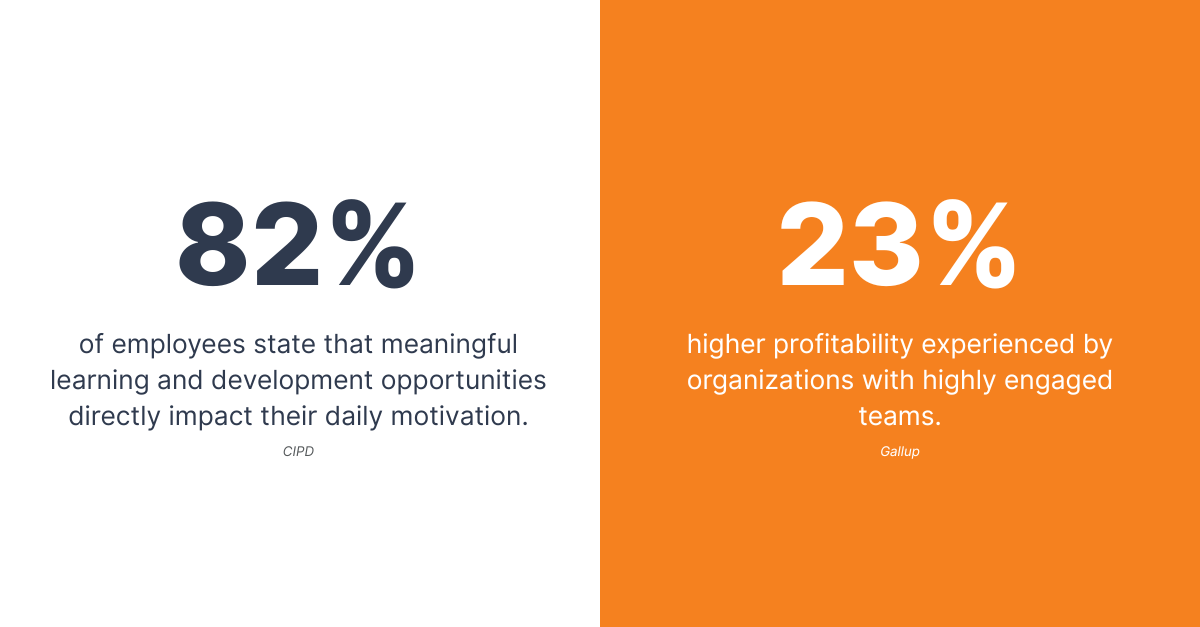
Data from the CIPD L&D Survey indicates that 82% of employees state that meaningful learning and development opportunities directly impact their daily motivation. When an organization makes a visible financial and structural commitment to an individual's intellect, the individual naturally reciprocates by investing greater discretionary effort into the organization's strategic goals.
The Strategic Value of Cross-Functional Rotations
Beyond formalized classroom or digital learning, experiential knowledge acquisition plays a critical role in maintaining workforce vitality. Implementing internal gig marketplaces or short-term cross-departmental rotations allows personnel to break the monotony of their daily routines while gaining a holistic understanding of the enterprise.
An accountant who spends a structured two-week rotation shadowing the product design team gains invaluable insights into corporate operations, leading to improved inter-departmental communication and systemic efficiency. These collaborative experiences build a cohesive corporate culture rooted in mutual understanding and shared purpose.
Pillar 4: Prioritize Structural and Psychological Well-Being
The modern corporate landscape presents unprecedented psychological demands. High-velocity market shifts, continuous digital connectivity, and evolving macroeconomic pressures have created a workforce operating on the edge of exhaustion. When chronic stress dominates an organizational culture, employee engagement degrades rapidly, replaced by absenteeism, operational errors, and widespread disillusionment.
A critical mistake in corporate well-being strategies is treating systemic stress as an individual problem to be solved with superficial wellness perks. Offering mindfulness applications, occasional catered lunches, or corporate yoga sessions while maintaining unrealistic workloads, ambiguous objectives, and toxic management practices is fundamentally ineffective. True well-being requires systemic, structural design.
Designing Sustainable Work Environments
To protect the psychological capital of the workforce, organizations must audit their structural workflows to design out unnecessary stressors. This includes establishing clear boundaries regarding digital communication outside of standard working hours, enforcing mandatory minimum vacation usage, and ensuring that staffing levels are realistically aligned with production targets.
The urgency of this structural realignment is highlighted by research from DHR Global Workforce Trends, which notes that 83% of professionals report experiencing workplace burnout, which now acts as a direct anchor dragging down motivation and output. Burnout is an institutional failure that demands institutional solutions.
Organizations must cultivate an environment of psychological safety where personnel feel secure raising concerns about workload capacity without fear of professional retaliation or being perceived as incompetent. When leadership normalizes honest conversations about operational bandwidth, teams can proactively redistribute tasks, adjust deadlines, and maintain sustainable productivity without crossing the threshold into exhaustion.
Deconstructing the Costs of Mental Disengagement
When psychological safety is neglected, the financial ramifications are severe. Organizations suffering from pervasive burnout encounter a steep rise in absenteeism and presenteeism, the state of being physically present but cognitively checked out.
By implementing structured mental health days, providing access to comprehensive Employee Assistance Programs (EAPs) that offer confidential professional counseling, and training executives to recognize the early behavioral warning signs of emotional exhaustion, enterprises protect their most valuable asset: human capability. A healthy workforce is a resilient, innovative workforce.
Pillar 5: Build Transparent, Equitable Career Progression Pathways
A primary driver of talent attrition is the perception of career dead-ends. When individuals cannot visualize a clear, logical, and merit-based trajectory within their current organization, they begin scanning the external market for progression. Ambiguity regarding promotion criteria breeds favoritism, resentment, and a profound sense of helplessness, all of which dismantle motivation.
To retain high-potential talent, corporations must democratize career development by creating highly visible, transparent, and objective progression frameworks. These frameworks must clearly define the specific competencies, behavioral benchmarks, and performance metrics required to transition from one corporate tier to the next.
Creating Dual-Career Tracks
A foundational flaw in many legacy corporate structures is the singular upward pathway: moving into people management. This structure forces elite individual contributors into managerial roles they may neither desire nor excel at, simply because it is the only mechanism available for financial and title advancement.
To resolve this structural bottleneck, progressive organizations implement dual-career tracks. This model places equal organizational value, prestige, and compensation opportunities on both the management trajectory and the individual contributor expert trajectory.
By explicitly mapping out these distinct pathways, organizations provide clarity and hope. Data from LinkedIn Workplace Learning confirms that employees who have clear, visible internal career progression paths are 3.5 times more engaged than those without visibility. This dramatic variance highlights how critical future orientation is to current performance. When an individual can clearly see their future within an organization, their daily output aligns naturally with the long-term strategic vision of the enterprise.
Democratizing Internal Mobility
In tandem with dual-career tracks, an open internal mobility policy is vital. Rather than hoarding talent within specific departments, corporate policies should encourage internal transfers and promotions. Vacant roles should be posted internally before being advertised to the external market, giving current personnel the first opportunity to advance.
When talent mobility is normalized and celebrated rather than resisted by protective managers, it fosters a dynamic internal ecosystem. Employees feel empowered to navigate their careers horizontally and vertically within the enterprise, breathing new life into different business units and retaining deep institutional knowledge within the corporate umbrella.
The Macroeconomic Imperative of Human Optimization
The strategic integration of these five pillars is not merely an exercise in corporate altruism; it is a hard-nosed financial imperative. In a hyper-competitive global marketplace where product lifecycles are shrinking and technological advantages are rapidly commoditized, the collective capability, creativity, and dedication of an organization's human capital constitute the ultimate sustainable competitive advantage.
To fully understand the scale of the challenge and the opportunity, executive leadership must examine the macro-level economic data surrounding workforce optimization. The cost of institutional neglect is staggering, while the returns on systematic cultural cultivation are profoundly transformative.
The Financial Cascades of Disengagement
When an enterprise operates with a disconnected workforce, the financial losses accumulate across multiple vectors. Decreased quality of output leads to heightened customer churn; low morale increases workplace safety incidents; and escalating voluntary attrition drives up recruitment, onboarding, and training costs.
|
Metric Area |
Impact of Disengaged Workforce |
Reward of Optimized Workplace |
|
Profitability |
Severe margin compression due to inefficiency |
23% Higher Profitability |
|
Productivity |
Pervasive presenteeism and operational drag |
18% Greater Productivity |
|
Attrition |
High voluntary turnover costs (1.5x–2x annual salary) |
Significantly reduced turnover; talent hoarding eliminated |
|
Macroeconomic Drag |
Contributes to a massive $10 trillion global loss |
Drives compound annual growth through stable innovation |
The broader economic reality is stark. According to data from the Gallup State of the Global Workplace, only 20% of employees globally are engaged at work, causing an estimated $10 trillion in lost productivity to the global economy. This systemic shortfall represents a massive, untapped reservoir of human potential. Organizations that successfully close this gap within their own operations will systematically outperform their industry peers.
The Return on Cultural Investment
Conversely, the data supporting purposeful cultural engineering is clear. As documented in a comprehensive Gallup Meta-Analysis, highly engaged business units experience 23% higher profitability and 18% greater productivity than their disengaged peers. These numbers demonstrate that human optimization directly drives bottom-line performance.
When workforce motivation is managed with the same analytical rigor, financial discipline, and strategic focus as capital allocation or technological deployment, the entire corporate ecosystem stabilizes. The enterprise encounters fewer operational disruptions, fosters greater internal innovation, and builds a powerful employer brand that naturally attracts top-tier talent from across the globe.
Conclusion
Driving sustainable workforce motivation is an ongoing operational commitment that requires deep structural integration across every level of the enterprise. By replacing obsolete annual feedback loops with real-time continuous listening channels, organizations can capture actionable insights and address workforce challenges dynamically.
Simultaneously, by equipping frontline managers with modern coaching frameworks and holding them accountable for team culture, companies bridge the gap between corporate vision and daily execution. Investing in continuous, accessible learning initiatives and constructing clear, dual-track career pathways ensures that personnel remain intellectually stimulated and can plan a long-term future within the corporate structure. Finally, safeguarding psychological safety and mitigating systemic burnout protects the vital human energy that powers the enterprise.
Ultimately, organizations that treat employee engagement as a foundational business strategy rather than a superficial HR initiative will secure a highly resilient, agile, and productive workforce capable of navigating complex market evolutions. The data confirms that the organizations willing to invest deeply in their human infrastructure are the ones that will define the future of corporate success.