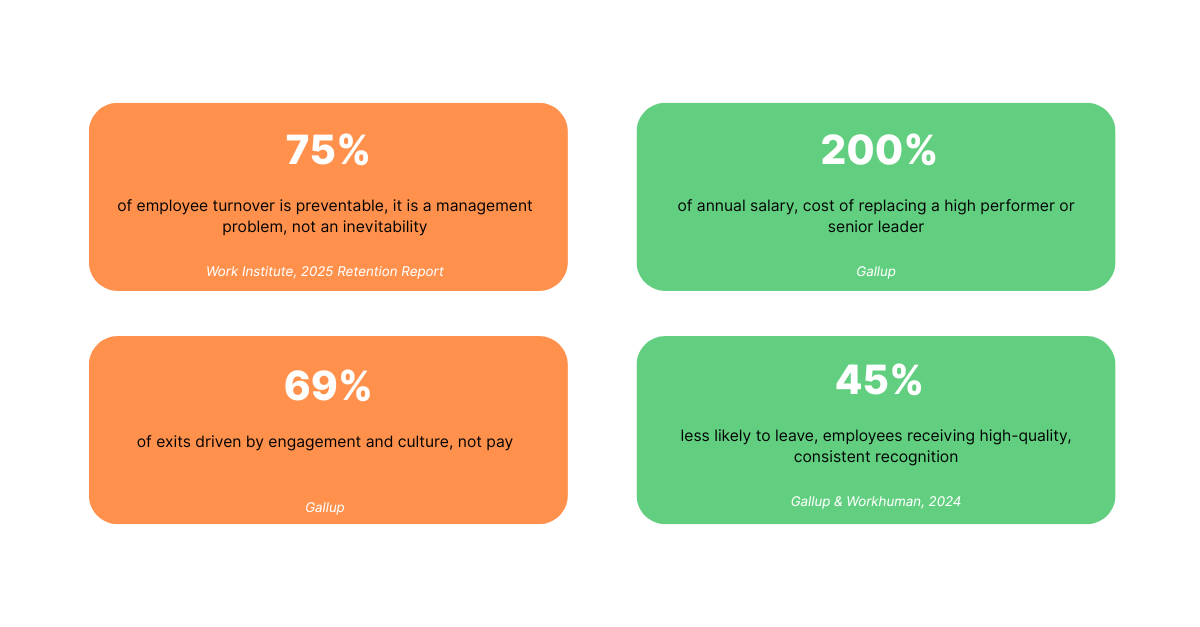
High performers do not leave suddenly. They leave after months of quietly receiving no meaningful feedback, no recognition, no direction, and no career development conversation. By the time the resignation letter arrives, the decision has long been made. And the cost of that departure is steep: replacing a high performer costs up to 200% of their annual salary, according to Gallup, and that figure does not include the knowledge, relationships, and team momentum that leave with them.
The performance management software your organization uses, and more specifically, how your managers use it, determines whether high performers stay, grow, and keep delivering, or disengage and walk out the door.
This article makes the case for continuous feedback as the single most impactful lever in high performer retention, explains why annual reviews are structurally inadequate for this group, and shows how modern performance management software gives HR teams and managers the tools to have better conversations, more often, before it is too late.
The Retention Crisis Is a Feedback Crisis in Disguise
Retention is near the top of every HR leader's agenda in 2026. According to Gartner, 87% of HR leaders say improving retention is a critical priority. Yet most organizations are trying to solve a feedback problem with retention tactics, better pay, flexible working, and perks that address the symptoms rather than the cause.
Gallup's research is unambiguous on this point: employee engagement and culture issues account for 69% of the reasons employees leave, far outweighing pay and benefits as exit drivers. And engagement, for most employees, comes down to one thing: do they feel seen, developed, and valued at work?
The answer, for most high performers, is no. Not because their managers don't care, but because performance management systems in most organizations are built around annual review cycles that were never designed to sustain engagement. They measure performance once a year, deliver feedback long after it is relevant, and produce outcomes that 85% of employees describe as demotivating rather than developmental, according to SelectSoftwareReviews.
High performers experience this failure more acutely than anyone else. They are ambitious, growth-oriented, and capable of delivering impact, but only when they receive the direction, recognition, and challenge that keep them engaged. Without continuous feedback, they do not coast. They leave.
Why Annual Performance Reviews Cannot Retain High Performers
The annual performance review has its place. But as the primary, or only, feedback mechanism in an organization, it fails high performers in four specific ways.
|
The Failure |
Why It Hits High Performers Hardest |
|
Feedback arrives months after the relevant work |
High performers want to know they are on the right track while they are doing the work, not at year-end when the moment has passed |
|
Recognition is compressed into a single conversation |
High performers deliver exceptional work throughout the year; acknowledging it once annually feels transactional, not genuine |
|
Development conversations are annual, not ongoing |
Ambitious employees need to see a growth trajectory; a once-a-year career conversation cannot sustain that sense of forward momentum |
|
Problems surface too late to fix |
By the time an annual review identifies disengagement in a high performer, they are often already interviewing elsewhere |
|
Only 14% of employees say reviews motivate improvement |
For high performers seeking stretch, challenge, and growth, a demotivating review process actively accelerates their exit decision |
A Familiar Pattern: The High Performer Who Left Without Warning
A Hypothetical Scenario: The Team Lead Who Stopped Raising Her Hand
Consider a professional services firm with 350 employees. Their most experienced project team lead, consistently rated in the top 10% of performers, began quietly disengaging in March. She had led three successful client engagements without any acknowledgment beyond her standard annual review in January. In April, she took on additional responsibilities at her manager's request, but no formal conversation about career progression followed. By June, she had stopped volunteering for new projects. By August, she had accepted a role at another firm.
Her exit interview cited "lack of development conversations" and "feeling invisible despite strong performance." Her manager was surprised. The annual review had been positive. What was missing was not recognition on paper; it was meaningful, timely feedback that connected her work to her future at the company.
The firm spent four months finding a replacement, paid 60% of her annual salary in recruitment and onboarding costs, and experienced a measurable drop in the client satisfaction scores her team had sustained for two years. A single additional check-in conversation per quarter, tied to her goal progress in a performance management system, might have changed the outcome.
Why Continuous Feedback Works? Especially for High Performers
Continuous feedback is not simply more frequent performance reviews. It is a different philosophy, one built around the idea that performance conversations happen when they are most useful: close to the work, relevant to the moment, and forward-looking rather than retrospective.
LinkedIn's 2025 Workplace Learning Report found that 94% of employees would stay longer at companies that invest in their development. For high performers, development is not a perk; it is a condition of engagement. Continuous feedback is the mechanism that makes ongoing development visible, actionable, and real.
It builds the sense of progress that high performers need
High performers are growth-oriented by nature. They need to see that they are moving forward in their skills, their impact, and their careers. Continuous feedback, tied to SMART goal tracking in an employee performance management software platform, creates a visible, ongoing record of progress that reinforces engagement month by month.
In contrast, an annual review that arrives in December to summarise a year's worth of work provides no real-time sense of direction. High performers who cannot see whether they are on track, or whether their work is valued as it happens, do not wait patiently. They look elsewhere for that signal.
It allows course-correction before disengagement deepens
Gallup and Workhuman's 2024 longitudinal research tracked nearly 3,500 employees over two years. The finding was striking: employees receiving high-quality, consistent recognition were 65% less likely to be actively looking for another job. Not recognition once a year at review time, but recognition that is timely, specific, and connected to real contributions.
The implication for performance management systems is direct. A platform that prompts managers to provide feedback after a project milestone, flags when a high performer has not received any formal recognition for 60 days, or surfaces goal completion data that triggers a development conversation; these are not nice-to-have features. They are a retention infrastructure.
It replaces recency bias with a fuller, fairer picture
Annual reviews are notoriously susceptible to recency bias, the tendency to evaluate an employee based on the last few weeks rather than the full year. High performers who have a difficult quarter near review time, or who work on long-cycle projects that deliver results after the review window, are often underrated relative to their actual contribution.
Continuous feedback mechanisms, check-ins, real-time recognition, rolling goal updates, and build an evidence-based record of performance throughout the year. When review time arrives, managers are evaluating based on a documented 12-month picture, not a six-week impression. This produces fairer assessments, which research consistently links to higher engagement and lower turnover intent.
It gives managers the data to have better conversations
Manager quality is the single most impactful variable in employee retention. Gallup's research shows that 75% of employees who feel supported by their manager report higher engagement. The challenge is that many managers, particularly those promoted for technical expertise, lack the tools, prompts, and data to conduct meaningful development conversations consistently.
Modern performance management software changes this. When a manager opens a check-in conversation with access to a team member's goal progress, recent feedback, skill development status, and review history, the conversation is grounded in evidence rather than impressions. OrangeHRM's performance management module provides exactly this context, giving managers a structured, data-rich environment for the kind of conversations that retain high performers.
How Performance Management Software Makes Continuous Feedback Practical
The most common reason continuous feedback does not happen is not intention, it is infrastructure. Managers who want to give better feedback need a system that makes it easy, consistent, and visible. That is the practical value of a purpose-built performance management platform.
Goal-setting and real-time progress tracking
When individual goals are set, documented, and tracked in an employee goal-setting software environment, progress becomes visible to both the employee and their manager at any time. High performers can see how their current work connects to their development objectives. Managers can see when a goal is at risk, when it has been achieved ahead of schedule, or when a stretch target needs to be added. These data points are the raw material of a meaningful feedback conversation.
OrangeHRM's performance management module supports configurable goal-setting frameworks that keep objectives visible and trackable throughout the year, not just at review time.
Continuous check-ins and feedback cycles
Structured check-ins, brief, regular, and documented, are the operational backbone of a continuous feedback culture. A weekly or biweekly 5-minute check-in, recorded in the performance management system, creates an ongoing feedback loop that keeps manager and employee aligned without the administrative weight of a full review process.
When these check-ins are built into the performance management platform, with standardized prompts, completion tracking, and a searchable history, managers are more likely to conduct them consistently. The system makes it easy to do the right thing, which is the most effective form of behavior change available to an HR team.
360-degree feedback for a richer performance picture
High performers benefit enormously from multi-rater feedback. 360-degree feedback software allows peers, direct reports, and cross-functional collaborators to contribute to a performance picture that no single manager can construct alone. For ambitious employees, this broader recognition, seeing that their impact is felt beyond their immediate team, is itself a retention factor.
It also surfaces development opportunities that manager-only feedback misses. A high performer who is technically outstanding but developing their leadership presence may receive consistent peer feedback on this dimension that triggers a targeted development conversation, one that directly serves their career trajectory.
Performance analytics that flag risk before it becomes resignation
The most advanced value of a continuous feedback infrastructure is the data it generates over time. When feedback frequency, goal completion rates, recognition patterns, and check-in history are all captured in a performance analytics dashboard, HR teams can identify the early warning signs of disengagement in high performers, not from a gut feeling, but from a pattern in the data.
An employee whose check-in completion rate has dropped, whose goal progress has stalled, and who has not received any recognition in 90 days is displaying a composite risk signal that a well-configured performance management system can surface, weeks or months before the resignation conversation.
The Real Challenges of Implementing Continuous Feedback
The shift from annual reviews to continuous feedback is the right direction. But it is not frictionless. HR teams should anticipate these challenges and plan for them.
Manager bandwidth and adoption
The most common objection to continuous feedback is time. Managers leading large teams, managing client deliverables, and handling operational pressures often struggle to add structured feedback conversations to an already full schedule. The solution is not to minimize the ask; it is to make the system do the heavy lifting. A performance management platform that sends automated check-in prompts, pre-populates agenda items from goal data, and takes no more than 10 minutes to complete per employee removes the friction that prevents adoption.
The tradeoff is real: if the system is complex, managers will avoid it. Simplicity of the manager experience is as important as feature richness when evaluating performance management software.
Feedback quality, not just frequency
More feedback is only more valuable if it is better feedback. Organizations that implement continuous feedback systems without investing in manager capability risk increasing the volume of generic, low-quality input, which research shows can be more damaging to high performer engagement than infrequent but substantive feedback.
Manager training, specifically on how to deliver specific, development-oriented feedback that connects to both performance data and career trajectory, is the non-negotiable companion investment to any performance management software implementation.
The risk of feedback overload
Continuous does not mean constant. High performers value depth of feedback over volume. A system designed to prompt daily micro-feedback across every interaction can create noise that drowns out the meaningful signal. The most effective implementations balance frequency with intentionality, weekly check-ins for routine progress, structured quarterly conversations for development and career direction, and real-time recognition for exceptional contributions.
How to Build a Continuous Feedback Culture: 6 Practical Steps
Step 1: Audit where your current feedback process breaks down.
Map the journey from goal-setting to review in your current performance management system. Where does feedback stop happening? Where do managers disengage from the process? Where do high performers report feeling least supported? This audit defines where the continuous feedback infrastructure needs to be built first.
Step 2: Choose performance management software that makes check-ins effortless.
The right performance management platform automates prompts, tracks completion, stores feedback history, and surfaces goal progress for every employee, without requiring managers to build their own systems. OrangeHRM's performance management module provides this infrastructure within a fully integrated HRIS, connecting performance data to leave, onboarding, and workforce analytics in a single platform.
Step 3: Set clear, visible goals at the start of every quarter.
Continuous feedback requires something to give feedback on. SMART goals, tracked in real time within the performance management system, give every check-in a concrete agenda. High performers in particular engage more deeply with feedback when it is tied to specific, measurable objectives they have ownership of.
Step 4: Introduce a structured check-in cadence and protect it.
A biweekly 15-minute check-in, built into the performance management platform as a scheduled and tracked activity, is more valuable than an elaborate quarterly review that gets cancelled or compressed. Protect the cadence by making it a visible management expectation, not an optional courtesy.
Step 5: Train managers to use feedback data, not just instinct.
Equip managers to open check-in conversations with the employee's goal progress, recent recognition history, and any development plan milestones from the performance management system. Data-grounded conversations are more specific, more motivating, and more likely to surface retention risks early.
Step 6: Close the loop visibly and track retention impact.
Establish a baseline of high-performer retention, check-in completion rates, and engagement scores before implementing a continuous feedback program. Review at 90 days, six months, and annually. The business case for continuous feedback becomes compelling quickly when retention cost savings are made visible.
Is Your Performance Management System Retaining High Performers? A Quick Diagnostic
-
Managers conduct structured feedback conversations at least once per month — not just at annual review time
-
Goals are visible to both manager and employee throughout the year, not just set and forgotten
-
High performers receive specific, documented recognition tied to real contributions within two weeks of delivery
-
Check-in history is stored in the performance management platform and is accessible to HR for pattern analysis
-
360-degree feedback is collected at least twice per year, not only during annual appraisals
-
Performance analytics flag employees who have not received feedback for more than 60 days
-
Development conversations explicitly address career trajectory, not just current role performance
Fewer than 4 ticks? Your performance management system is likely contributing to preventable high-performer attrition.
Conclusion
Every resignation from a high performer carries the same underlying story: somewhere in the months before the letter arrived, the feedback stopped being meaningful. The check-ins became cursory. The development conversations were deferred. The recognition was limited to an annual review that felt like a formality rather than a genuine assessment of impact.
Continuous feedback changes that story. Not by adding more meetings or generating more paperwork, but by building a performance management infrastructure that makes it easy for managers to stay connected, for employees to see their progress, and for HR teams to catch the signals of disengagement before they become irreversible decisions.
The right performance management software is the foundation of that infrastructure. OrangeHRM's performance management module is designed to make continuous feedback practical, with configurable check-in cycles, SMART goal tracking, 360-degree feedback, and a performance analytics dashboard that gives HR leaders visibility across the entire workforce. It is built for organizations that want to retain their best people, not just measure their performance once a year.
Ready to build a performance management system that retains high performers?
Book a FREE demo of OrangeHRM and see how continuous feedback, goal tracking, and 360-degree reviews work together in a single, integrated HR platform.