
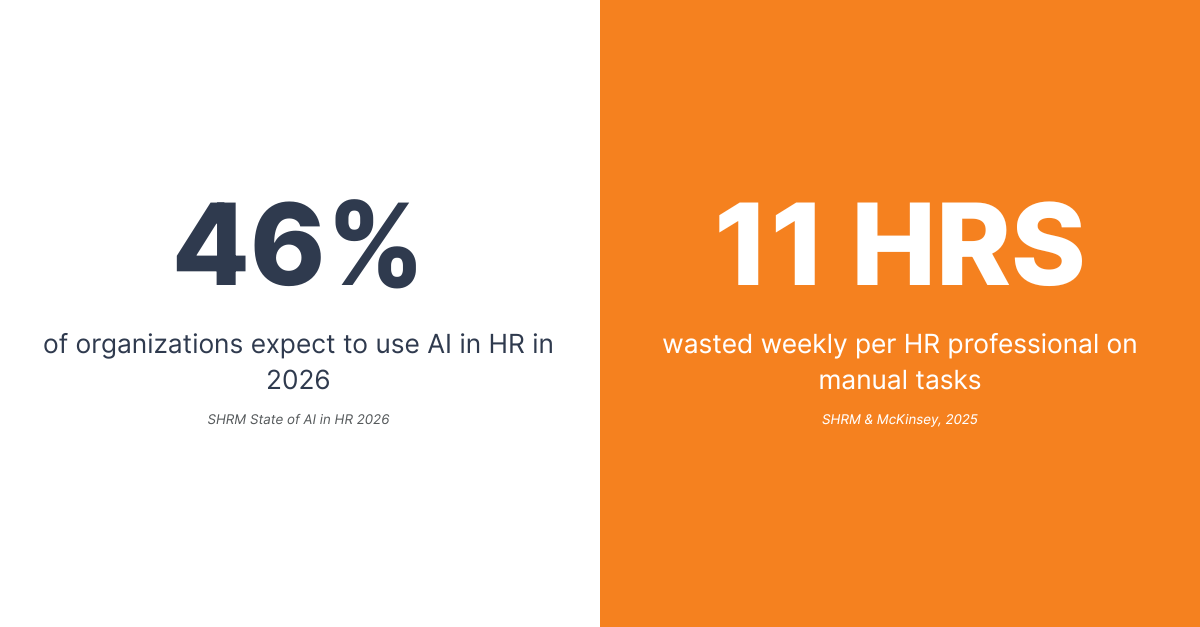
More than half of all organizations worldwide have yet to adopt any form of AI in their HR operations, yet the window for inaction is closing. According to SHRM's State of AI in HR 2026 Report, 46% of organizations now expect to use AI in HR this year. The HR teams moving first are not just saving time. They are making faster hiring decisions, running more consistent performance reviews, and giving employees instant answers to HR queries, around the clock.
The challenge is knowing which AI features actually deliver value, and which are marketing labels on basic automation. The answer starts with looking at what genuinely AI-powered HR software does in practice: not just storing data and processing rules, but understanding context, surfacing insights, and making HR workflows smarter.
OrangeHRM AI, the AI-powered layer built into the OrangeHRM platform, currently offers five live AI features, with more in active development. This article explores each one in depth: what it does, how it works in a real HR environment, and why it represents a meaningful step forward from traditional HR software.
Why AI in HR Software Matters Now
The business case for AI in HR is no longer abstract. Gartner has identified realising AI value as one of the top priorities for CHROs in 2026. SHRM research shows that HR teams currently waste up to 11 hours per week per professional on manual, repetitive tasks, data entry, leave queries, scheduling, and record management, which AI is purpose-built to handle.
At the same time, the risks of poorly implemented AI are real. Algorithmic bias in recruitment, opaque automated decisions, and employee data privacy are all legitimate concerns. The right approach, and the one OrangeHRM has taken, is human-in-the-loop AI: AI that proposes, assists, and surfaces insights, while humans retain full control to review, edit, or override every recommendation. Every OrangeHRM AI feature is built on this principle.
OrangeHRM AI: Five Live Features at a Glance
OrangeHRM AI currently delivers five AI-powered capabilities across the employee lifecycle, from recruitment through to performance management. Each is designed to solve a specific, recurring HR pain point.
|
AI Feature |
What It Solves |
|
Citra Chat, AI Chat Assistant |
Employees are spending HR time on routine self-service queries instead of strategic work |
|
Query Company Documents |
Employees unsure of policies; managers lacking instant compliance guidance |
|
Performance Appraisal Summarization |
Hours of manual review consolidation, inconsistency, and recency bias in appraisals |
|
Goal Generation Assistance |
Vague, misaligned goals that don't connect individual work to organizational strategy |
|
Job Fit Scoring |
Slow, inconsistent CV screening prone to unconscious bias |
The 5 OrangeHRM AI Features Explained
Citra Chat: Your AI HR Chat Assistant
HR made conversational, not complicated.
What it does:
-
Apply for or approve leave through a simple chat command
-
View who is on leave and check leave balances in real time
-
Retrieve employee information without navigating HR menus
-
Create internal surveys directly from the chat interface
In Practice: An employee needs to check their remaining annual leave and submit a request before a meeting starts. Instead of logging into the HR system, navigating to the leave module, and submitting a form, they type a single message to Citra and the request is submitted in under 30 seconds. The manager receives a notification and can approve directly from the chat, no portal login required.
Citra is the conversational layer that sits across OrangeHRM's HR workflows. For HR teams, it removes a significant volume of inbound queries, the constant stream of 'how many days leave do I have?', 'who is out today?', 'can you find that employee's details?' that consume disproportionate HR time relative to their strategic value.
For employees, it transforms the experience of interacting with HR systems. Instead of navigating complex menus or waiting for HR to respond to emails, common tasks are completed through natural language in seconds.
Query Company Documents: Your AI Compliance Assistant
Immediate, document-backed answers, aligned to your actual policies.
What it does:
-
Get immediate answers to any employee query backed by company documents
-
Automatically aligns guidance with leave blackout periods and attendance rules
-
Manage HR tasks hands-free using conversational voice-to-text
In Practice: A manager wants to know whether an employee is eligible to take leave during a blackout period ahead of a major product launch. Rather than searching through the HR policy manual or emailing the HR team, they ask Citra, and receive an immediate, document-backed answer that references the specific policy and confirms the relevant attendance rules. The answer is accurate because it is drawn from the organization's own uploaded documents, not a generic knowledge base.
This feature addresses one of the most persistent HR time sinks: answering questions that are already answered in policy documents, which employees either cannot find or do not know exist. By connecting Citra to the organization's own documentation, OrangeHRM AI turns a passive document library into an active, queriable compliance resource.
The voice-to-text capability extends this further for managers in operational environments, retail floors, manufacturing facilities, and healthcare settings, where accessing a desktop HR system is impractical. Speaking a query and receiving an accurate, policy-aligned answer removes a friction point that has historically meant compliance guidance simply goes unchecked.
Performance Appraisal Summarization
AI reads, you decide. Human judgment stays at the center.
What it does:
-
Reads evaluator comments from completed appraisals and generates an objective summary
-
Automatically categorizes sentiments, strengths, areas for development, key achievements
-
Saves significant hours of manual review consolidation
-
Promotes fairness and consistency across reviewers
-
Human-in-the-loop by design: HR retains full control to review, edit, or reject every AI-generated summary
In Practice: An HR Manager is preparing calibration materials for an annual review cycle covering 80 employees across four departments. Without AI, consolidating individual reviewer comments into coherent, comparable summaries takes two full days. With OrangeHRM's Appraisal Summarization feature, AI generates draft summaries for each employee's appraisal, categorized by sentiment and ready for HR review, in a fraction of the time. The HR Manager reviews, edits where necessary, and approves. The AI handles the volume; the human handles the judgment.
One of the most important design decisions in OrangeHRM's AI approach is the explicit human-in-the-loop architecture. The AI generates a summary, it does not publish one. HR retains full authority to review, modify, or reject any output before it becomes part of the official performance record.
This matters particularly for performance management, where the consequences of an inaccurate or unfair assessment are significant. AI summarisation eliminates the mechanical burden of consolidating review data; it does not replace the HR professional's role in interpreting that data and making decisions about people.
There is also a consistency benefit that is easy to underestimate. When different managers write appraisal comments in different styles and with different levels of detail, manual consolidation by HR introduces variability that disadvantages some employees. AI summarisation applies the same analytical lens to every appraisal, producing comparable outputs that make calibration more equitable.
Goal Generation Assistance
From vague intentions to SMART goals, aligned to the work that actually matters.
What it does:
-
AI recommends SMART goals tailored to each employee's role, past feedback, and historical progress
-
Ensures individual goals align with department and organizational objectives
-
Removes guesswork from goal-setting for managers and employees alike
-
Helps build meaningful, measurable goals, not vague checklists
In Practice: During a quarterly performance check-in, a team leader needs to set goals with a recently promoted employee moving into a new role. The manager is experienced but unfamiliar with what meaningful goals look like for this specific position. OrangeHRM AI analyzes the employee's role profile, previous performance data, and organizational objectives, then suggests a set of SMART goals as a starting point. The manager and employee review the suggestions together, refine two of them to better reflect the team's current priorities, and finalize the goals within the same session.
Poor goal-setting is one of the most widespread, underappreciated performance management problems. Research consistently shows that employees with clearly defined, meaningful goals are significantly more engaged and productive than those with vague or unmeasured objectives. Yet in practice, goal-setting conversations are often rushed, rely on copied-forward goals from previous cycles, or produce targets so broad they are impossible to evaluate.
OrangeHRM's Goal Generation Assistance addresses this by bringing relevant data into the goal-setting conversation, not just suggesting goals generically, but tailoring suggestions to the specific employee's history and context. The result is a starting point that is already grounded in evidence, which managers and employees can adapt rather than create from scratch.
Job Fit Scoring: AI-Assisted Candidate Screening
Fair, consistent, faster, AI as your recruitment assistant, not your gatekeeper.
What it does:
-
Compares each resume against the specific requirements of the job description
-
Generates a Job Fit Score indicating the degree of alignment between candidate and role
-
Summarises key resume insights so recruiters can focus on the most relevant details
-
Reduces unconscious bias by applying the same evaluation criteria to every applicant
-
Helps recruiters focus attention on the most qualified candidates earlier in the process
In Practice: A growing technology company posts a role and receives 180 applications within 72 hours. The in-house recruiter has three other active roles to manage simultaneously. OrangeHRM's Job Fit Scoring feature evaluates each application against the job description, generating a fit score and a brief summary of each candidate's relevant experience. The recruiter reviews the top-scored applications first, quickly validates the AI's assessments against the summaries, and builds a shortlist in a fraction of the time a manual read would require.
The phrase 'AI as your assistant, not a gatekeeper' reflects an important principle in how OrangeHRM has designed this feature. Job Fit Scoring does not make hiring decisions, it surfaces information and provides a structured starting point for the recruiter's own judgment.
This distinction matters for compliance. As SHRM's 2026 research highlights, 57% of HR professionals in US states with AI employment regulations are unaware of the applicable laws. Recruitment AI that operates as an autonomous gatekeeper creates legal exposure. Recruitment AI that assists and informs a human recruiter, which is OrangeHRM's approach, preserves accountability while delivering efficiency.
The bias-reduction benefit is also meaningful in practice. Human recruiters, however skilled, are susceptible to cognitive biases that affect initial CV screening: name recognition, formatting preferences, institutional familiarity. Applying the same criteria systematically to every application does not eliminate bias entirely, but it reduces the most common early-stage inconsistencies and supports a more equitable shortlisting process.
How OrangeHRM Protects Employee Data in Its AI Features
For HR leaders evaluating AI-powered software, data privacy is a non-negotiable consideration. OrangeHRM AI is built on the following commitments:
OrangeHRM AI Data Privacy Principles
-
All personally identifiable information (PII) is anonymized before AI processing
-
Zero-retention policy for chat logs and processed content, data is not stored after use
-
OrangeHRM never uses customer data to train third-party AI models
-
Human-in-the-loop design: AI recommends, HR decides, no autonomous HR decisions
Full details are available at OrangeHRM's AI Principles page: orangehrm.com/ai-principles
These commitments directly address the concerns most commonly raised by HR leaders when evaluating AI software: will our employees' data be used to train AI models? Who has access to AI-generated outputs? Can our team override or correct automated recommendations? OrangeHRM's answers are transparent and unambiguous.
What HR Teams Should Know Before Adopting AI HR Software
AI features in HR software deliver genuine value, but only when implemented thoughtfully. The following are the most important considerations for HR teams moving to AI-powered workflows.
Data Quality Determines AI Quality
OrangeHRM's Goal Generation Assistance draws on role profiles, past feedback, and performance history. Its Job Fit Scoring evaluates resumes against job descriptions. Both features are only as reliable as the data they work with. Inconsistent job descriptions, incomplete performance records, or outdated employee profiles will produce lower-quality AI outputs. Before activating AI features, HR teams benefit from a data audit, ensuring the underlying HR records are accurate, standardised, and current.
Change Management is as Important as the Technology
Employees adopting Citra Chat, managers reviewing AI-generated appraisal summaries, and recruiters using Job Fit Scores all require some orientation to use these features effectively. The risk is not that employees will distrust AI in principle, it is that without clear communication about what AI does and does not do in these workflows, adoption will be patchy and the value will be uneven. A brief internal communication explaining each feature, its purpose, and its limits goes a long way.
AI Assists It Does Not Decide
This is the most important principle to communicate to the HR team and to employees. OrangeHRM AI generates summaries, scores, and suggestions, but HR professionals retain full authority over every decision. Appraisal summaries are reviewed and edited before use. Job Fit Scores inform but do not replace recruiter judgment. Goal suggestions are starting points for a conversation, not mandates. When employees and managers understand this, the trust and adoption dynamics are considerably more positive.
Conclusion
The five AI features currently live in OrangeHRM are not novelties or experiments, they are direct responses to the most persistent inefficiencies in daily HR work. Citra Chat eliminates the routine query overload that consumes HR team bandwidth. The Document Query feature turns static policy documents into an active, always-available compliance resource. Performance Appraisal Summarization removes the mechanical burden from review consolidation without removing HR judgment from the process. Goal Generation Assistance closes the gap between strategic objectives and individual performance conversations. Job Fit Scoring brings consistency and speed to candidate screening without reducing the recruiter's role to rubber-stamping.
What ties these features together is the human-in-the-loop principle: AI that assists, informs, and accelerates, while keeping HR professionals firmly in control of every decision that matters. That balance is what separates genuinely useful AI HR software from systems that automate for automation's sake.
Ready to see what OrangeHRM can do for your organization? Book a FREE demo today!