According to a July 2025 Gartner survey of 222 CHROs, fewer than half (47%) said their organization's culture actually drives employee performance today. Performance management is the system that determines whether your people know what's expected of them, get useful feedback, and grow in a direction that also moves the business forward. Done well, it's the single highest-leverage process an HR team runs. Done poorly, it becomes an annual ritual everyone dreads, and nobody trusts.
This guide covers the full picture: the core process, the major frameworks, how the discipline is evolving, where it breaks down in practice, and how to build, or fix, a system that actually works. Whether you're running reviews day to day, setting strategy from the top, or evaluating software at enterprise scale, you'll find a dedicated section written for exactly that vantage point.
What Is Performance Management?
This is the ongoing process of setting clear expectations, tracking progress toward goals, delivering feedback, and evaluating results to help employees grow while aligning their work with organizational objectives. It isn't a single event, it's a continuous cycle that touches goal-setting, coaching, feedback, evaluation, and development planning throughout the employee lifecycle.
That definition matters because the term gets flattened in everyday conversation into "the thing that happens once a year with a form." It's much bigger than that. A well-run system connects individual contribution to company strategy, gives managers a structured way to coach rather than just judge, and gives employees a clear, ongoing sense of where they stand, not a surprise delivered in December.
The Discipline vs. the Single Appraisal, What's the Difference
These two terms, the broader discipline and the single review event, get used interchangeably, and that confusion causes real problems. A performance appraisal is one evaluation moment: typically a form, a rating, and a conversation that happens once or twice a year. It's a snapshot.
The broader discipline is the entire system surrounding that snapshot: goal-setting at the start of the cycle, check-ins throughout, coaching in the moment, development planning after the review, and the rating itself as just one input among several. Treating the appraisal as the whole system is exactly what leads to the "faulty annual ritual" problem, organizations invest heavily in the form and the meeting, but skip the ongoing work that makes the eventual rating fair and useful. A closer look at how this concept has evolved breaks down how the definition itself has shifted as the discipline matured, and why so many HR teams still default to the narrower, event-based version of it.
Common Misconceptions Worth Retiring
A few beliefs about employee evaluation persist well past their usefulness:
-
"More frequent reviews mean softer standards." In practice, the opposite tends to be true, frequent, low-stakes feedback catches problems earlier, when they're easier and less painful to correct.
-
"A rating scale makes evaluation objective." A scale creates the appearance of objectivity. Without calibration across managers, the same rating can mean very different things depending on who assigns it.
-
"Performance and potential are the same thing." Performance measures what someone has already delivered. Potential measures capacity for a different or bigger role. Conflating the two is a common reason promising employees get passed over for roles they were never fairly evaluated against.
-
"Software will fix a broken process." Technology removes administrative friction, it can't repair a framework that was never designed well in the first place. Fixing the process has to come before choosing the tool.
A Brief History: From Annual Ratings to Continuous Feedback
For most of the 20th century, employee evaluation was a once-a-year administrative task tied almost exclusively to compensation decisions, a manager filled out a form, assigned a numeric rating, and filed it. The process was backward-looking by design: it documented what had already happened rather than shaping what happened next.
That model started cracking in the 2010s, when several major employers publicly abandoned forced ranking and annual-only cycles in favor of frequent check-ins. The shift wasn't cosmetic, it reflected growing evidence that feedback loses most of its value the longer it's delayed. A rating delivered in December can't influence a project that went sideways in March; it can only describe it after the fact. That single insight, that timing determines usefulness, is the thread connecting almost every modern development in this space, from continuous feedback tools to real-time goal tracking to AI-assisted review drafting.
The shift has also been generational. Employees entering the workforce over the last decade have consistently reported wanting more frequent feedback than the annual model ever provided, and organizations slow to adapt have felt that mismatch show up in engagement scores and exit interviews alike.
Why Employee Performance Programs Matter
The business case isn't abstract. Organizations with structured, well-run evaluation programs consistently outperform those without one on the metrics that matter most to leadership.
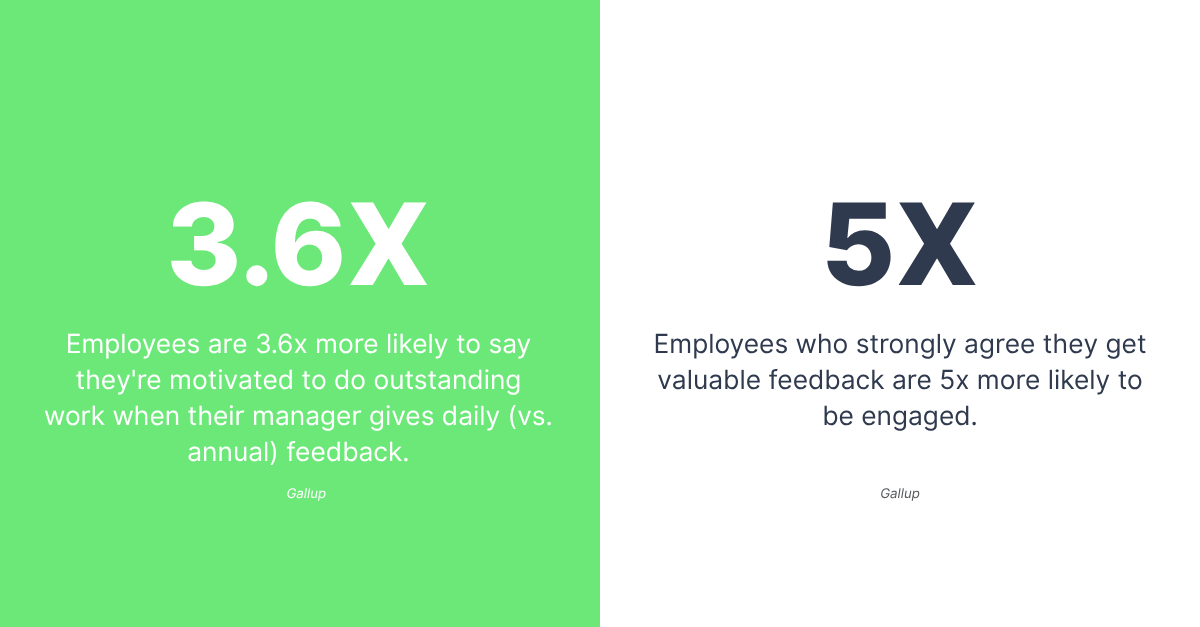
Gallup and Workhuman research shows employees who strongly agree they receive valuable feedback from the people they work with are five times as likely to be engaged, and well-recognized employees are 45% less likely to have turned over two years later.
Three outcomes show up repeatedly in the research and in practitioner experience:
-
Retention - Employees who understand how their work connects to something larger, and who receive regular feedback on that work, are measurably less likely to leave. Ambiguity about where you stand is one of the most common reasons cited in exit interviews, not the absence of a review, but the absence of clarity.
-
Productivity - Clear goals reduce wasted effort. When employees can see exactly what "good" looks like, they spend less time guessing and more time executing. Teams operating under vague or shifting expectations tend to show measurably lower goal-completion rates, independent of individual effort or skill.
-
Manager Effectiveness - A structured cadence of check-ins and reviews gives managers, many of whom received no formal training in giving feedback, a repeatable framework to lean on, rather than improvising difficult conversations from scratch. This matters disproportionately for first-time managers, who are statistically the most likely to avoid or delay hard conversations without a structured process forcing the issue.
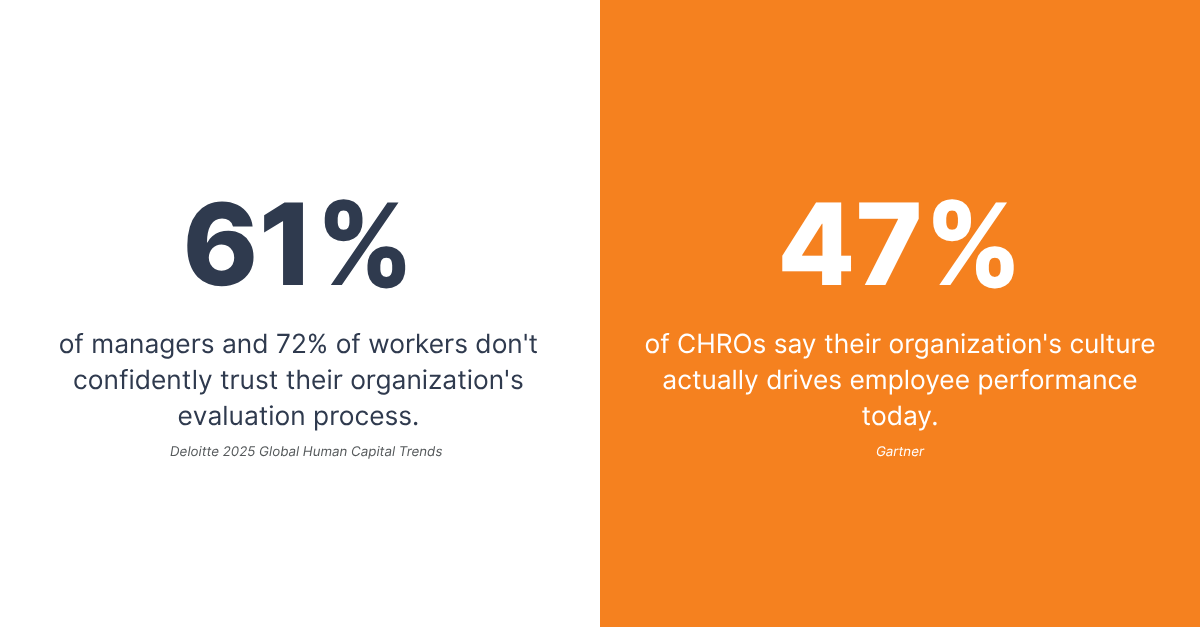
There's also a trust dimension that's easy to underestimate. Deloitte's 2025 Global Human Capital Trends survey found that 61% of managers and 72% of workers could not confidently say they trust their organization's evaluation process. That gap matters because a review cycle nobody trusts produces ratings nobody acts on with confidence. The process runs, the forms get filed, but the underlying goal of a fair, useful evaluation quietly fails regardless.
There's a quieter cost too: trust erosion. Employees who go through a review cycle that feels arbitrary, inconsistent across teams, or disconnected from any real outcome don't just disengage from that process, the disengagement bleeds into how they feel about the organization broadly. A system that's transparent about how ratings are reached, even an imperfect one, tends to retain more trust than a black-box process with a polished form attached to it.
This is why the business case for investing in a genuinely well-run system extends beyond any single metric on a dashboard. Retention, productivity, and manager effectiveness are the outcomes leadership tends to ask about directly, but trust is the substrate underneath all three, a workforce that doesn't trust how it's being evaluated will eventually show weaker numbers on every other metric, even if the immediate cause looks unrelated to evaluation at first glance. Treating trust as a measurable, protectable asset rather than an intangible byproduct is usually what separates organizations that sustain a strong evaluation culture for years from those that see it decay a cycle or two after the initial rollout excitement fades.
The Performance Management Process: 5 Core Stages
Whatever framework or software sits on top of it, the underlying process breaks down into five stages that repeat in a cycle, typically annually, quarterly, or continuously depending on the organization's maturity.
|
Stage |
Primary Activity |
Owner |
Typical Cadence |
|
1. Planning |
Set goals and expectations |
Manager + employee |
Start of each cycle |
|
2. Monitoring |
Track progress, surface blockers |
Manager, ongoing |
Weekly or biweekly |
|
3. Development |
Coach, train, remove obstacles |
Manager |
Ongoing |
|
4. Evaluation |
Rate, calibrate, gather multi-source feedback |
Manager + HR |
End of cycle |
|
5. Recognition |
Reward, promote, or plan next cycle |
Manager + HR |
Post-evaluation |
1. Planning & Goal Setting
Every cycle starts here, and it's the stage most likely to be rushed. Goals need to be specific enough to be measurable and connected explicitly to a team or company objective, vague goals ("improve communication") are nearly impossible to evaluate fairly later. Most organizations use either SMART goals (Specific, Measurable, Achievable, Relevant, Time-bound) or OKRs (Objectives and Key Results) as the structuring framework, both are covered in detail in the next section.
A practical detail that gets skipped: goals set in isolation, without the employee's input, tend to produce lower buy-in than goals negotiated collaboratively, even when the final target ends up identical. The conversation matters as much as the number.
2. Monitoring & Feedback
This is the stage that separates a modern system from a legacy one. Instead of waiting for a scheduled review, effective monitoring means brief, regular check-ins, weekly or biweekly one-on-ones where goals get revisited, and blockers get surfaced while there's still time to act on them. The absence of this stage is the single biggest reason annual-only systems feel disconnected from day-to-day reality.
Consider a simple scenario: a sales rep falls behind pace in month two of a quarter. In a system with regular monitoring, that gap surfaces in a check-in within days, and the manager can adjust coaching or resourcing immediately. In an annual-only system, that same gap doesn't get formally addressed until the year-end review, ten months after it would have been most useful to catch.
3. Coaching & Development
Feedback without support is just criticism. This stage is where a manager identifies what an employee needs, a skill gap to close, a resource to unblock, a stretch assignment to test readiness for more responsibility, and actively works toward it, rather than simply noting a shortfall on a form.
Development plans work best when they're specific and time-bound, mirroring the same discipline applied to goal-setting: a named skill, a named method for building it (a course, a mentor, a project assignment), and a checkpoint date to assess progress.
4. Evaluation & Calibration
This is the stage most people mean when they say "review time": a structured assessment against the goals set in stage one, often incorporating input from more than just the direct manager. Multi-source evaluation, commonly called 360-degree feedback, reduces the effect of any single rater's bias.
Calibration, a cross-manager conversation to align rating standards before results are finalized, is what keeps one manager's "meets expectations" from meaning something different than another's. Skipping calibration is one of the most common, and most consequential, shortcuts organizations take under deadline pressure.
5. Recognition & Reward
The cycle closes with a decision: how does this evaluation translate into compensation, promotion, or a development plan for next cycle? Organizations that skip this step, running rigorous reviews that lead to no visible consequence, tend to see participation and trust in the process erode quickly. Employees notice when the process doesn't connect to outcomes, and that noticing compounds cycle over cycle.
Performance Frameworks Compared
There's no single "correct" framework, the right choice depends on how fast-moving your business objectives are and how much administrative overhead your managers can absorb.
OKRs vs. KPIs vs. MBO
|
Framework |
Best For |
How It Works |
Typical Review Cadence |
|
OKRs (Objectives & Key Results) |
Fast-moving, growth-stage organizations |
An ambitious qualitative Objective paired with 2–5 measurable Key Results |
Quarterly |
|
KPIs (Key Performance Indicators) |
Steady-state operational roles |
Ongoing metrics tracked continuously against a target, without a defined end date |
Continuous |
|
MBO (Management by Objectives) |
Traditional, hierarchy-driven organizations |
Goals cascade top-down from company objectives to individual targets |
Annual |
OKRs tend to suit organizations where priorities shift quarter to quarter, the framework is explicitly designed to be revisited and rewritten often, and a certain amount of "stretch" is expected; hitting 100% of every Key Result every quarter usually signals goals were set too conservatively, not that the team is performing perfectly. KPIs suit roles with stable, ongoing responsibilities where the goal is sustained performance rather than a milestone, a customer support team's average resolution time is a KPI, not an OKR. MBO, the oldest of the three, still works well in traditional structures but struggles in environments where strategy changes faster than the annual cycle it assumes.
Many mature organizations blend two of the three: OKRs for cross-functional strategic initiatives, KPIs for the steady operational work that keeps the business running underneath those initiatives.
360-Degree Feedback Explained
A 360-degree review collects input from an employee's manager, peers, direct reports, and sometimes external stakeholders, rather than relying on a single evaluator. The value is straightforward: any one person's view of someone's contribution is partial. A manager sees deliverables and deadlines; peers see collaboration and reliability; direct reports see leadership style. Combined, these views produce a far more complete and more defensible picture than a single manager's opinion.
The tradeoff is administrative weight: gathering, anonymizing, and synthesizing input from multiple raters takes real coordination, which is exactly the kind of task that benefits from software rather than a shared spreadsheet. Poorly run 360 processes also carry a specific risk, if anonymity isn't genuinely protected, participants self-censor, and the entire value of multi-source input collapses.
Performance Improvement Plans (PIPs), When and How
A Performance Improvement Plan is a formal, time-bound document used when an employee is falling meaningfully short of expectations and needs a structured path back to acceptable performance, or clear documentation if they don't reach it. A well-constructed PIP includes:
-
Specific, measurable gaps (not "attitude problems" concrete, observable shortfalls)
-
A defined timeline, typically 30–90 days
-
Support the organization commits to providing (training, check-in cadence, resources)
-
Clear criteria for what "successful completion" looks like
PIPs get a bad reputation because they're sometimes used purely as a documentation step ahead of termination rather than a genuine improvement tool. Used correctly, with real support behind it, a PIP can and does turn around underperformance. Used as a formality, it damages trust across the whole team, not just with the employee on the plan, because colleagues generally know when a PIP was never intended to succeed.
Management by Objectives (MBO) in Practice
MBO predates both OKRs and modern KPI dashboards, but it hasn't disappeared, it's simply less visible in fast-growing tech companies than in longer-established, hierarchical organizations. The mechanism is straightforward: senior leadership sets a small number of company-wide objectives, those cascade down through each layer of management, and each individual's goals are derived directly from their manager's goals rather than negotiated independently.
The strength of MBO is clarity of alignment, it's structurally very hard for an individual's goals to drift far from company strategy, because every goal traces back through an explicit chain. The weakness is rigidity: because the cascade takes real time to design and communicate, MBO structures tend to be set annually and rarely revisited mid-cycle, which is exactly the brittleness that pushed many organizations toward OKRs when their competitive environment started shifting faster than a yearly cascade could accommodate.
Employee Net Promoter Score and Engagement Signals
A metric worth mentioning alongside the core frameworks, even though it isn't a performance framework on its own: employee engagement surveys, sometimes summarized as an eNPS (employee Net Promoter Score), correlate closely enough with performance outcomes that many HR teams track them side by side with goal-completion data. A team with strong goal completion but a sharply declining engagement score is often a leading indicator of a burnout-driven performance drop that hasn't shown up in the numbers yet, which is one reason a purely metrics-driven view of evaluation, without any engagement signal alongside it, can miss real problems until they're already visible in attrition.
Competency Frameworks and Rating Scales
A competency framework defines the specific skills and behaviors expected at each role and level, the difference between a "Senior" and "Staff" title, made explicit rather than left to interpretation. Pairing this with a consistent rating scale (commonly a 3, 4, or 5-point scale) gives evaluators a shared vocabulary, which is what calibration conversations depend on.
Without a shared framework, two managers rating the same behavior can land on completely different scores, not because the employees differ, but because the standards do. Organizations that skip this step often discover the gap only when an employee transfers teams and receives a wildly different rating for comparable work, which is usually when trust in the whole system takes the biggest hit.
Why Organizations Are Moving Away from the Annual Cycle
The single biggest shift in this discipline over the past decade has been the move from once-a-year evaluation toward continuous, ongoing feedback. The rationale is timing: an annual review compresses twelve months of work into one backward-looking conversation, which flattens nuance and rewards whatever happened most recently in the manager's memory, a well-documented effect called recency bias.
The case for moving beyond once-a-year reviews lays out why this shift isn't just a management fad it directly addresses the disengagement and mistrust that traditional annual cycles tend to produce, replacing a single high-stakes event with an ongoing, lower-stakes rhythm of coaching and feedback.
Goal Alignment in a Continuous Model
One structural problem with annual goal-setting is that it assumes business priorities stay fixed for twelve months, which they rarely do. A continuous model breaks annual objectives into smaller, revisitable milestones, so goals stay relevant even as strategy shifts mid-year. How continuous check-ins keep goals from going stale walks through why frequent, short check-ins, reviewing progress, clearing roadblocks, and adjusting priorities do a better job of keeping individual work tied to what the business actually needs right now, rather than what it needed when the goal was written.
Continuous Feedback vs. the Traditional Annual Review
The core distinction between the two models comes down to timing, not effort. A side-by-side breakdown of both models frames it clearly: one model corrects course while performance is still unfolding; the other only documents it once the year has already closed. Short, frequent conversations replace the single annual meeting, supported by ongoing goal tracking rather than a once-a-year form. Organizations adopting this model report meaningfully higher engagement, not because the standards are lower, but because feedback arrives while it can still change the outcome.
Objections to Continuous Feedback, and How to Answer Them
Skepticism toward moving away from an annual-only model is common, and usually falls into a few predictable categories worth addressing directly rather than dismissing.
"Our managers barely have time for one review a year, how will they handle check-ins every two weeks?" The honest answer is that a 15-minute biweekly check-in typically takes less cumulative manager time over a quarter than the hours spent reconstructing an entire year from memory for a single annual review. The time isn't additional, it's redistributed, and redistributed feedback tends to be far more useful than the same total hours spent once a year.
"Won't more frequent feedback just mean more opportunities for things to go wrong?" More touchpoints mean more opportunities to catch a problem early, which is precisely the point. A single annual review isn't lower-risk, it just delays discovering the risk until it's harder to fix.
"Employees might find constant feedback exhausting rather than helpful." This concern is valid when the check-in cadence turns into another form of surveillance rather than genuine coaching. The distinction is tone and purpose: a check-in framed around removing blockers and supporting progress lands very differently than one that feels like a running scorecard. Getting this distinction right in manager training matters more than the cadence itself.
"We already tried something like this, and it didn't stick." Most failed attempts at continuous feedback fail for an operational reason, not a conceptual one usually a documentation format too heavy to sustain, or a lack of genuine manager accountability for holding the check-ins. Diagnosing which of those two failed before assuming the whole model doesn't work is worth the effort before abandoning it a second time.
What Continuous Actually Requires Operationally
Switching models on paper is easy; running the operational reality is where most attempts stall. A genuinely continuous model requires managers to actually hold the frequent check-ins, not just have the capability to, which means building the habit through calendar discipline, not just software access. It also requires a lighter-weight documentation standard: nobody wants to write a full narrative every two weeks, so the format for a check-in note needs to be fast enough that skipping it never feels like the easier option.
Performance Metrics and KPIs That Actually Tell You Something
Not every metric an organization tracks is worth tracking. The goal is signal, not volume, a handful of well-chosen indicators tell you more than a dashboard full of vanity numbers.
Quantitative vs. Qualitative Indicators
Quantitative indicators are the numbers: goal completion rate, review cycle participation, time-to-close for a review cycle, distribution of ratings across the organization. These are useful for spotting systemic issues, a 40% goal completion rate across an entire department signals a planning problem, not an individual one.
Qualitative indicators are harder to quantify but often more revealing: the substance of written feedback, the themes that show up across multiple 360-degree reviews, whether development conversations are actually happening or just being logged. A system that only tracks the numbers can look healthy on paper while producing shallow, unhelpful feedback in practice, which is why both dimensions need attention, not just the one that's easy to put in a spreadsheet.
Common Bias and Rating-Scale Pitfalls
A handful of well-documented biases distort evaluation results if they aren't actively managed:
-
Recency Bias - weighting the last few weeks of a cycle far more heavily than the rest of it
-
Halo/Horn Effect - letting one strong or weak trait color the entire evaluation
-
Central Tendency Bias - rating everyone as "average" to avoid difficult conversations
-
Similar-to-Me Bias - unconsciously rating employees who share the evaluator's background or working style more favorably
Calibration sessions, where managers compare and justify ratings across teams before finalizing them, are the most effective structural defense against all four. Software that flags rating-distribution anomalies (for example, one manager rating every direct report identically) can surface these patterns for HR to investigate before results go final.
Building a Simple Metrics Dashboard
A minimal, useful dashboard usually needs no more than five or six figures tracked over time: goal completion rate by team, review cycle completion and on-time rate, rating distribution (to catch calibration outliers), 360-feedback participation rate, and time-to-close for the current cycle. Anything beyond that risks burying the signal that actually predicts problems, a spike in low ratings from one manager, or a department whose goal completion has quietly dropped two quarters running, under noise nobody has time to review.
Trend lines matter more than single-cycle snapshots for almost every one of these figures. A goal completion rate of 70% means very little in isolation, it's only informative relative to what that same team achieved last cycle, and the cycle before that. A department trending downward from 85% to 75% to 65% over three consecutive quarters is a far stronger signal than any single number, and it's the kind of pattern a dashboard built around trend lines catches early, while a dashboard built around static snapshots tends to miss until the decline is already severe.
Managing Performance Across Remote and Hybrid Teams
Distributed teams change what "monitoring" and "feedback" have to look like in practice, independent of any framework choice. When a manager can't observe work happening in real time, a conversation overheard, a visibly stressed team member, body language in a meeting, the entire system becomes more dependent on deliberate, structured check-ins rather than the informal signals that fill the gaps in a co-located office.
A few adjustments matter disproportionately for distributed teams:
-
Written check-in notes become the default, not the exception. What used to be an informal hallway update needs a lightweight written equivalent, or progress simply goes unrecorded until the next scheduled meeting.
-
Output-based goals outperform activity-based ones. Without visibility into how someone's day is structured, evaluating "hours visibly at a desk" is both impossible and the wrong thing to measure anyway, goals need to be framed around deliverables, not presence.
-
Feedback timing needs to be more deliberate. A quick in-person correction that would happen naturally in an office needs a scheduled equivalent, a short async message or a brief call, or it simply doesn't happen at all.
-
Calibration conversations need more structure across time zones. Cross-manager calibration is harder to run informally when managers aren't in the same room; a documented rating rationale per employee makes async calibration far more workable than relying on a live discussion everyone can actually attend.
None of this requires a different framework, OKRs, KPIs, and 360-degree feedback all still apply. What changes is the discipline required to make monitoring and feedback happen deliberately rather than incidentally.
How Evaluation Connects to Compensation and Promotion
A review that produces a rating and nothing else is, functionally, just documentation. The stage that gives the whole cycle its weight is the link between evaluation results and real outcomes, compensation adjustments, promotion decisions, or a development plan that visibly shapes what happens next.
This connection needs to be structured, not case-by-case. A compensation framework that maps rating bands to salary adjustment ranges (for example, a defined range for "exceeds expectations" versus "meets expectations") removes a huge amount of ad hoc negotiation and perceived favoritism from the process. The same logic applies to promotion: a promotion decision made without reference to structured evaluation history, relying instead on a manager's informal impression, is exactly the kind of decision that erodes trust when it's later scrutinized for consistency or fairness.
Organizations that get this right typically build the connection into the calendar itself: compensation review windows are scheduled to follow directly after evaluation cycles close, so there's no ambiguous gap where employees are left wondering whether the review actually mattered.
Running the Process as an HR Manager
If you're the person actually operating this system day to day, your job is less about designing the framework and more about making sure it runs smoothly across dozens or hundreds of employees without becoming an administrative bottleneck.
The practical priorities at this level: keeping review cycles on schedule without chasing managers individually, ensuring rating scales are applied consistently across teams, and catching the employees who are falling through the cracks, the ones whose manager hasn't logged a single check-in all quarter. A recurring pattern worth watching for: managers who consistently submit reviews at the deadline, with minimal detail, are often the same managers whose teams show weaker engagement scores, the two tend to travel together.
A practical manager's playbook for the full cycle walks through this operational side in depth: how to build a rollout checklist, how to train managers who've never given structured feedback before, and how to spot a cycle that's quietly falling apart before it reaches the deadline.
A practical habit worth building into every cycle: a mid-cycle health check, roughly halfway between planning and evaluation, that simply asks each manager whether check-ins are actually happening. Catching a manager who's gone silent at the midpoint is far easier to correct than discovering it during the final evaluation rush.
Troubleshooting the Most Common Operational Problems
A short field guide to the issues that come up most often once a cycle is underway:
-
A manager submits every review at the exact deadline, with minimal detail. This is rarely a time-management issue alone, it's usually a sign the manager hasn't been running real check-ins throughout the cycle and is reconstructing the whole quarter from memory at the last minute. The fix is upstream: a mid-cycle nudge, not a deadline reminder.
-
Ratings cluster suspiciously tightly around "meets expectations" across an entire team. This pattern, central tendency bias at scale, usually means a manager is avoiding the discomfort of differentiating performance. It's worth a direct conversation before results are finalized, not after.
-
An employee disputes a rating they feel came out of nowhere. This almost always traces back to a monitoring-stage failure, feedback that should have been delivered mid-cycle instead surfaced for the first time in the formal evaluation. The long-term fix is enforcing the check-in cadence; the short-term fix is acknowledging the timing gap honestly rather than defending the rating as if it were a surprise-free process.
-
Participation drops in the self-assessment or 360-feedback step. Low participation is usually a trust signal, not a laziness signal, it often means a previous cycle's feedback felt like it went nowhere. Addressing the underlying trust issue matters more than chasing completion rates.
Building Strategy as an HR Director or CHRO
At the director or CHRO level, the questions shift from "is this cycle running on time" to "is this system actually producing the outcomes the business needs." That means connecting evaluation data to retention and productivity metrics you can defend in front of the executive team, and making the case, in dollars, not just in HR language, for why the investment in a structured program pays off.
This is also where the build-versus-buy and framework decisions get made: whether to move from annual to continuous cycles, whether OKRs suit the organization's pace better than KPIs, and how to phase in change without disrupting a cycle already in progress. The strongest CHRO-level cases tie every recommendation back to a business outcome, turnover cost avoided, time-to-productivity for new hires shortened, a documented lift in goal completion after a framework change, rather than presenting the shift as a philosophical preference.
A useful discipline at this level: treat every major framework change as a pilot with a defined measurement window, not a permanent switch decided in a single meeting. Rolling a continuous model out to two or three business units for one full cycle, then comparing engagement and goal-completion data against the units still running the old model, gives you something far stronger to bring to the executive team than a confident assertion that the new approach is better.
Making the ROI Case in Numbers the Executive Team Will Trust
A CHRO pitching a framework change fares far better with a concrete calculation than with a values-based argument, however true the values-based argument might be. A simple version: take the organization's average fully-loaded cost of a regretted departure, recruiting, onboarding, and lost productivity during ramp-up, commonly estimated at anywhere from half to twice the departing employee's annual salary depending on role seniority, and multiply it by the number of departures a pilot group avoided relative to a comparable control group over the measurement window. Pair that avoided-cost figure with the administrative hours saved by reduced manager time spent on annual-only documentation, and the resulting case tends to land with a CFO far more effectively than an appeal to employee experience alone, even when employee experience was the original motivation for making the change.
Evaluating Systems at Enterprise Scale
For an enterprise buyer, the evaluation criteria expand well beyond feature checklists. Compliance matters, can the system produce a defensible audit trail if a rating decision is ever challenged? Integration matters, does it sit cleanly alongside existing payroll, SSO, and reporting infrastructure, or does it create a new island of data? Rollout complexity matters, can a multi-entity organization with different review cadences per business unit actually configure this without custom development work?
Total cost of ownership is where many enterprise evaluations go wrong: the sticker price on a per-seat license often understates the real cost once implementation, training, and ongoing administration are factored in. A system that's cheaper per seat but requires a dedicated administrator to keep running isn't necessarily cheaper overall.
A practical enterprise evaluation checklist worth running before any vendor demo:
-
Can review cycles be configured differently per business unit without professional services engagement?
-
Does the audit trail capture who changed a rating, when, and why, not just the final number?
-
What's the actual implementation timeline for an organization of your size, based on comparable case studies rather than vendor estimates?
-
How does the platform handle a mid-cycle reorganization, do reviews-in-progress survive a manager change cleanly?
-
What's included in the base license versus billed as a professional-services add-on?
Change Management at Scale
Buying the right software solves only part of the enterprise problem, rolling it out to thousands of employees and hundreds of managers, many of whom are attached to whatever process (or lack of one) they've used for years, is a change-management exercise in its own right. The organizations that navigate this well tend to share a few habits: they pilot with a visibly supportive business unit first and use that group's results as internal proof rather than trying to convince skeptics with a vendor's marketing material; they invest in manager training specifically, since managers, not employees, are the ones who determine whether a new process feels like progress or like more paperwork; and they resist the temptation to migrate every historical review into the new system at launch, since a clean start with clear expectations tends to land better than a mountain of imported legacy data nobody asked to see.
Data Migration and Historical Records
A related, frequently underestimated question: what happens to years of historical review data sitting in the outgoing system? Some of that history has real value, it's evidence for promotion cases, compensation history, and pattern recognition on manager rating tendencies. Losing it entirely on a system switch is a real cost, but importing all of it uncritically can also import old inconsistencies (miscalibrated ratings, inconsistent formats) into a fresh system meant to fix exactly that problem. Most enterprise rollouts land on a middle path: migrate the structured data (ratings, goals, dates) that supports compensation and promotion history, and archive rather than import free-text narrative fields that don't map cleanly to the new system's format.
AI and the Future of Employee Evaluation
Artificial intelligence is reshaping this discipline faster than almost any other HR function, mostly by removing the administrative friction that made continuous feedback impractical at scale for so long.
AI-Assisted Reviews and Bias Reduction
AI tools can now draft review summaries from existing check-in notes, goal updates, and feedback, turning what used to be hours of writing into a starting draft a manager edits and approves. This isn't the same as automating the decision itself. OrangeHRM's approach to this is explicitly human-in-the-loop: AI proposes a summary, and the human evaluator decides, the technology accelerates the writing, not the judgment.
Used well, this kind of tool also reduces certain biases: an AI system applying consistent criteria across every review is less susceptible to the halo effect or similar-to-me bias than a rushed manager writing five reviews back-to-back on a Friday afternoon.
Skills-Based Development Models
A parallel shift is happening in what gets evaluated in the first place. Traditional systems evaluate against a job title's fixed responsibilities; skills-based models evaluate against a portable inventory of competencies that can move with an employee across roles. This matters increasingly as internal mobility becomes a bigger retention lever, an evaluation system built around skills, not just title-bound duties, makes it far easier to identify who's ready for a lateral move or a stretch assignment.
Real-Time Feedback Tools
The technical infrastructure behind continuous models has matured considerably: mobile check-in prompts, always-on goal dashboards, and feedback that can be logged the moment it's relevant rather than saved for a scheduled meeting. The effect compounds, the easier it is to log feedback in the moment, the more feedback actually gets logged, and the less any single review cycle has to reconstruct from memory.
What AI Should Not Be Trusted to Do Alone
It's worth being direct about the limits here. AI-drafted summaries are only as good as the notes feeding them, a manager who never logged a check-in gives the system nothing to summarize accurately. And any rating decision with real consequences for someone's compensation or career deserves a human evaluator's final judgment, not an algorithmic score treated as the final word. The organizations getting the most value from AI in this space treat it explicitly as a drafting accelerant, not a decision-maker.
A Manager's-Eye View of the Difference
Consider the practical difference for a manager writing five reviews in one afternoon. Without AI assistance, each review starts from a blank page, the manager scrolls back through months of scattered notes, Slack messages, and half-remembered conversations, trying to reconstruct a fair account of the quarter. With an AI-assisted draft pulling directly from logged check-ins and goal updates, the manager starts instead from a structured first pass covering the right ground, and spends their time editing for accuracy and adding the judgment calls only they can make, which employee showed real growth versus which one just had a lucky quarter, for instance. The time saved isn't really about speed for its own sake; it's that the manager's limited attention shifts away from data reconstruction and toward the parts of the review that actually require a human's judgment.
Adoption Patterns Worth Watching
Organizations introducing AI-assisted drafting for the first time tend to see a predictable adoption curve: skepticism in the first cycle (managers rewrite most of the draft rather than trust it), followed by growing reliance once the tool proves it's genuinely working from the manager's own logged notes rather than generating generic language. The tools that lose trust quickly are the ones that produce plausible-sounding but generic summaries disconnected from what actually happened, which is exactly why a human-in-the-loop design, where the AI's output is always presented as an editable draft rather than a final artifact, tends to earn sustained adoption where a more automated approach doesn't.
Is Your Process Actually Working? A Health Check
Beyond the individual metrics covered earlier, it's worth periodically stepping back and asking whether the system as a whole is achieving what it was built for, a question that's easy to lose sight of once a cycle becomes routine.
A short set of honest questions worth asking every year or two:
-
Do employees trust the process, or just comply with it? These are different things. A survey question as simple as "I believe my last evaluation was fair", tracked over time, reveals more than participation rates alone ever will.
-
Has manager quality in delivering feedback actually improved, or has the paperwork just gotten more sophisticated? A more polished form doesn't automatically produce a better conversation. If training hasn't kept pace with process changes, the underlying conversation quality may not have moved at all.
-
Is the evaluation actually predictive of anything? Do the employees rated highly go on to succeed in bigger roles, and do the ones flagged as underperforming genuinely improve or exit? If ratings show no relationship to what happens next, the evaluation criteria themselves may be measuring the wrong things.
-
Would removing the process change anything? This is an uncomfortable but clarifying question. If managers would coach and give feedback just as effectively without the formal structure, the structure may have become a documentation exercise rather than a genuine driver of better performance, worth knowing, and worth fixing, rather than assuming the system is earning its administrative cost by default.
Running this kind of health check honestly is uncomfortable, because it can surface that a well-established process isn't actually delivering the outcomes it was designed for. That discomfort is exactly why most organizations skip it, and exactly why the ones that do run it tend to have systems that keep improving rather than quietly calcifying into ritual.
Common Mistakes That Undermine Performance Programs
Even well-intentioned systems fail in predictable ways:
-
Treating the annual form as the entire system. Skipping the ongoing check-ins that make the eventual rating fair is the single most common root cause behind a program that technically runs but doesn't actually help anyone.
-
Vague goals set once and never revisited. By the time review season arrives, nobody remembers the original context the goal was written in, and evaluating against a goal nobody can clearly recall isn't fair to the employee or the manager.
-
No calibration step. Ratings vary wildly by manager, with no mechanism to catch it, until an employee transfer or a promotion review exposes the inconsistency in an uncomfortable way.
-
Recognition disconnected from evaluation. Rigorous reviews that lead to no visible consequence erode trust fast, employees stop taking the process seriously once they've seen it not matter once.
-
Overloading managers with process. A system that takes hours of administrative work per employee will get abandoned or rushed under deadline pressure, and a rushed review is barely better than no review at all.
-
Running the exact same cadence regardless of role. A fast-moving product team and a steady-state finance team rarely need identical review frequency; forcing one cadence onto both usually under-serves one of them.
How to Build a Performance Framework From Scratch
For teams starting without an existing structure, here's a practical build sequence:
-
Define the Objective - Decide upfront whether the primary goal is development, compensation decisions, or both, this shapes every downstream choice, including how heavily the process leans on numeric ratings versus narrative feedback.
-
Choose a Cadence - Annual, quarterly, or continuous, pick based on how fast your business priorities actually change, not on what looks most modern.
-
Select a Goal Framework - OKRs for fast-moving priorities, KPIs for steady-state roles, or a blend of both across different parts of the organization.
-
Build the Rating Structure - A simple 4-point scale with clear behavioral anchors beats a complex 10-point scale nobody can consistently apply.
-
Train Managers Before Launch - A framework is only as good as the manager delivering the conversation, skipping training is the most common reason new systems underperform in year one.
-
Pilot With One Team - Run a full cycle with a small, engaged group before rolling out organization-wide, this surfaces configuration gaps and manager readiness issues in a low-risk setting.
-
Calibrate Before Finalizing Ratings - Build the cross-manager review step into the calendar from day one, not as an afterthought once ratings look inconsistent.
-
Close the Loop On Outcomes - Confirm, before the first cycle launches, exactly how results will connect to compensation, promotion, or development, and communicate that connection to employees ahead of time, not after the fact.
A Worked Example: One Team's 90-Day Cycle
Abstract frameworks are easier to evaluate against a concrete walkthrough. Here's how the five-stage cycle plays out for a mid-sized customer support team over a single quarter.
Week 1, Planning - The support manager sits down with each of the eight team members individually. Rather than assigning identical goals to everyone, each person leaves with two or three individualized targets tied to a shared team KPI, average resolution time, plus one personal development goal chosen collaboratively (one rep wants to build escalation-handling skills; another wants exposure to a new product line).
Weeks 2-10, Monitoring and Coaching - The manager runs 15-minute biweekly check-ins with each rep. These aren't formal reviews, they're short conversations covering what's going well, what's stuck, and whether the original goal still makes sense given how the quarter is unfolding. In week 5, one rep's resolution time spikes noticeably. Because the check-in cadence exists, the manager catches this in week 6 rather than at quarter-end, and traces it to a knowledge-base gap on a newly launched feature, a fixable problem, caught while there's still time to fix it.
Week 11, Self-Assessment and Peer Input - Each team member completes a short self-assessment, and two peers provide brief input on collaboration and knowledge-sharing, a lightweight version of 360-degree feedback, scaled to fit a support team rather than a full leadership review.
Week 12, Evaluation and Calibration - The manager drafts ratings, then compares them against two peer managers running similar teams, checking that "meets expectations" means roughly the same thing across all three teams before anything is finalized.
Week 13, Recognition and Next-Cycle Planning - Ratings translate into a small quarterly bonus pool distribution and inform the goals set for the next quarter, including a stretch assignment for the rep who wanted escalation-handling exposure, based directly on the development goal set back in week 1.
Nothing in this walkthrough required elaborate technology, a shared tracker and calendar discipline would work at this scale. What it required was consistency: the check-ins actually happened, the calibration step wasn't skipped, and the outcome connected visibly back to the goals set at the start.
Adapting the Process by Team Type
The five-stage cycle holds constant across roles, but what gets measured and how often should flex by team type. Treating a sales team and a design team identically tends to under-serve one of them.
|
Team Type |
What to Emphasize |
Typical Cadence |
|
Sales |
Quantitative targets (pipeline, close rate, quota attainment) alongside qualitative coaching on approach |
Frequent, often monthly, given how fast pipeline data changes |
|
Engineering / Product |
Output quality and collaboration alongside delivery timelines; avoid over-indexing on ticket-closure counts alone |
Quarterly, aligned to sprint or release cycles |
|
Creative / Design |
Qualitative peer and stakeholder feedback carries more weight than any single metric |
Project-based check-ins, formal review quarterly or biannually |
|
Operations / Support |
Consistency metrics (resolution time, accuracy) paired with individualized development goals |
Biweekly monitoring, formal evaluation quarterly |
|
People Leaders / Managers |
Team outcomes and manager-effectiveness signals (check-in consistency, calibration accuracy) in addition to individual output |
Quarterly, with an added layer reviewing how well they're running the process for their own team |
The common thread: every team type still runs through the same five stages, but the weight given to quantitative versus qualitative input, and the frequency of formal evaluation, should be set deliberately rather than inherited by default from whatever cadence HR standardized for the whole company.
Documentation: What to Keep and Why
Every evaluation cycle produces a paper trail, and how that trail is kept matters more than most organizations initially assume, both for fairness and for practical protection if a rating decision is ever challenged.
At minimum, retain: the original goals set at the start of the cycle (so the eventual evaluation can be checked against what was actually agreed to, not a shifted memory of it), dated check-in notes throughout the cycle, the final rating with a brief written rationale, and any calibration notes explaining why a rating was adjusted relative to the initial draft.
A good rule of thumb: documentation should be detailed enough that someone outside the original conversation, a new manager inheriting the team, or HR investigating a dispute, could read the record and understand how the final rating was reached, without needing to ask the original manager to reconstruct it from memory. Vague documentation ("did fine this quarter") protects no one and helps no one, including the manager who wrote it.
Rolling Out a New Framework: A Communication Plan
Even a well-designed change fails if employees hear about it secondhand or experience it as a surprise. A rollout communication sequence that tends to work:
-
Announce the why before the what. Explain the problem being solved (inconsistent ratings, feedback arriving too late to matter, whatever the actual driver was) before walking through the new mechanics, people accept process change more readily when they understand the reasoning behind it.
-
Give managers a head start. Train and brief managers at least two to three weeks before employees hear about the change, so managers can answer questions confidently rather than learning the new process alongside their own teams in real time.
-
Set expectations about the transition cycle explicitly. The first cycle under a new framework is rarely as smooth as the fifth one. Telling employees upfront that this is a pilot cycle, with feedback actively being collected on the process itself, reduces frustration when early friction inevitably shows up.
-
Create a visible feedback channel on the new process itself. A short survey or open channel for employees to flag what's confusing or not working, reviewed and acted on before the next cycle, signals that the rollout is a genuine iteration rather than a one-way mandate.
-
Share what changed, and why, after the first cycle closes. Closing the loop "here's what we heard, here's what we adjusted" is what separates a rollout that builds trust from one that just adds a new process on top of old skepticism.
Choosing the Right Performance Management Software
Software should reduce administrative burden, not add to it. Evaluate any platform against these criteria:
|
# |
Criterion |
Why It Matters |
|
1 |
Configurable review cycles |
Annual, quarterly, and continuous needs rarely fit one rigid template |
|
2 |
360-degree feedback support |
Multi-rater input needs structured collection, not manual spreadsheet aggregation |
|
3 |
Goal/OKR tracking |
Goals need to stay visible between reviews, not just at the start and end |
|
4 |
Calibration tools |
A way to compare ratings across managers before finalizing |
|
5 |
Mobile access |
Managers give better in-the-moment feedback if it doesn't require sitting at a desktop |
|
6 |
Integration with existing HR stack |
A standalone tool that doesn't sync with payroll or SSO creates a data island |
|
7 |
Reporting and analytics |
You need to see rating distribution, participation, and completion at a glance |
|
8 |
AI-assisted drafting (human-in-the-loop) |
Speeds up writing without removing the manager's judgment from the decision |
If a platform satisfies fewer than six of these eight, keep evaluating. It's also worth running a short pilot before committing at scale, select two or three teams with engaged managers and run a full review cycle through the platform before an organization-wide rollout. A pilot surfaces configuration gaps and adoption friction in a low-risk environment, before those issues affect every active review conversation across the company.
How this category of software actually works goes deeper on what's under the hood, and our current market roundup benchmarks ten platforms against this exact checklist if you're comparing specific vendors head to head.
What This Costs at Different Company Sizes
Budget expectations shift substantially by organization size, and it's worth setting realistic ones before evaluating vendors. A small team of under 50 employees often does perfectly well on a free or low-cost tier that covers the core cycle, goal tracking, a basic review form, simple reporting, without needing advanced calibration tooling or deep customization. Mid-market organizations, typically in the low hundreds of employees, tend to need configurable review cycles, 360-degree feedback support, and integration with existing payroll or SSO systems, which is where per-seat pricing on paid tiers starts to matter more in the overall calculation.
At enterprise scale, the software license itself is often the smaller line item, implementation services, manager training, data migration, and ongoing administration typically cost more in aggregate than the per-seat fee over a multi-year period. This is exactly why the total-cost-of-ownership framing introduced earlier matters more as headcount grows: a platform that looks like the budget-friendly option on a per-seat comparison sheet can end up being the more expensive choice once the full implementation and administration burden is priced in.
How OrangeHRM Supports Employee Performance and Growth
Every stage covered in this guide, goal setting, ongoing feedback, 360-degree evaluation, calibration, and development planning, maps directly to a capability inside OrangeHRM's Performance Management module. Configurable review cycles support annual, quarterly, or continuous cadences without forcing a single rigid template on every team. 360° reviews collect input from managers, peers, and direct reports in one structured workflow instead of scattered spreadsheets.
AI appraisal summarization drafts review language from existing notes and goals, with the evaluator always making the final call, while AI goal generation suggests SMART objectives based on role and history, cutting down the blank-page problem at the start of every cycle. The module is built easily so teams of any size can build a structured evaluation practice without a licensing barrier standing in the way of getting started.
Want the full picture before deciding what fits your organization? Our free ebook on modern employee evaluation breaks down where traditional review models fall short and what a modern replacement looks like in practice.
Performance Conversations: A Framework for Difficult Feedback
Every evaluation system eventually requires a manager to deliver feedback the employee doesn't want to hear, and this is the moment where even a well-designed process can fall apart if the manager isn't equipped for the conversation itself.
A simple structure that holds up under pressure:
-
Lead with the specific behavior, not a character judgment. "You missed the last two client deadlines" is actionable; "you're not reliable" is not, the first can be discussed and improved, the second just produces defensiveness.
-
Connect the behavior to a concrete impact. Explain what actually happened as a result, a client escalation, a delayed launch, a colleague who had to absorb extra work, rather than leaving the significance implied.
-
Ask before assuming. A missed deadline might reflect a skill gap, a resourcing problem, or something happening outside work entirely. Asking what got in the way, before proposing a fix, usually surfaces the real cause faster than guessing.
-
Agree on a specific next step with a checkpoint. Vague resolutions ("try to do better") don't give either party anything to evaluate later. A concrete commitment with a date attached does.
-
Follow up before the next formal review, not at it. Feedback that waits until the next scheduled evaluation to check whether anything changed has already lost most of its value, a brief follow-up within a few weeks confirms whether the conversation actually landed.
This structure works whether the feedback is being delivered as part of a quarterly check-in or a formal evaluation, the format around it changes, but the mechanics of a fair, specific, actionable conversation don't.
Templates You Can Use
Two lightweight formats worth adapting directly, rather than building from scratch:
A biweekly check-in template (5 minutes to complete):
-
What did you accomplish since our last check-in?
-
What's blocking you right now, if anything?
-
Does your current goal still make sense given what's changed this cycle?
-
Anything you need from me before we talk again?
A goal-setting template (used at the start of each cycle):
-
Goal statement (specific, measurable outcome)
-
How this connects to the team or company objective it supports
-
Success criteria, what does "achieved" look like, concretely?
-
Check-in checkpoints, when will progress get reviewed before the final evaluation?
-
Support needed, training, resources, or manager involvement required to hit this goal
Both templates are deliberately short. A check-in or goal template that takes twenty minutes to fill out is a template that gets skipped under deadline pressure, the entire value of a lightweight format is that skipping it never feels like the easier option.
Conclusion
Getting this right isn't about picking the trendiest framework, it's about building a rhythm of clear goals, timely feedback, and fair evaluation that employees can actually trust, cycle after cycle. A genuinely effective performance management approach starts with the process, chooses the framework that matches how fast your organization actually moves, and lets the software absorb the administrative weight rather than add to it.
None of this needs to happen all at once. Most organizations that end up with a mature, trusted system got there by fixing one stage at a time, adding real calibration this year, moving to a lighter check-in cadence next year, rather than attempting a complete overhaul in a single cycle. Incremental, well-communicated change tends to stick; a sweeping relaunch that overwhelms managers in its first quarter rarely does.