
Every hire starts with the same question: how does an organization find, evaluate, and secure the right person before a competitor does? Recruitment is the process organizations use to answer that question, attracting candidates, screening applicants, and turning the best fit into an employee. That process looks different than it did even two years ago. Skills-based hiring is now the dominant approach among HR leaders, and AI has become the most widely adopted technology across every HR software category, led by talent acquisition, according to Software Advice's 2026 HR and people trends research. This guide covers the full hiring lifecycle in depth: the process itself, the strategies working right now, AI's growing role, the metrics that matter, the software teams use to run it all, compliance considerations by region, inclusive hiring practices, remote hiring logistics, and practical templates a team can put to use immediately.
Hiring vs. Talent Acquisition: What's the Difference?
The hiring process is the work of identifying, attracting, evaluating, and bringing on qualified candidates to fill a specific open role. It spans everything from workforce planning and job posting through interviewing, selection, and the offer stage, ending when a candidate accepts and formally becomes an employee.
The term is often used interchangeably with talent acquisition, but there's a useful distinction: hiring typically refers to the tactical, role-by-role work of filling a specific vacancy, while talent acquisition describes the broader, ongoing strategy, employer branding, talent pipelines, workforce planning, that makes each individual hire easier. Most organizations run both at once: a hiring process for immediate openings, layered on top of a longer-term talent strategy.
The distinction matters more than it might first appear, because it changes who owns what. A hiring manager might own the tactical decisions for a single role, which candidates advance, who gets the offer. A talent acquisition leader owns the systems that make every future hiring decision easier: the employer brand that gets the right candidates applying in the first place, the referral program that keeps a pipeline warm, the data infrastructure that tells the organization which sourcing channels actually convert. Neither function works well without the other. A brilliant employer brand doesn't matter if the hiring process itself is slow and disorganized; a fast, well-run hiring process doesn't matter much if it's drawing from the wrong pool of candidates to begin with.
Smaller organizations often collapse both functions into one HR generalist or a single recruiter. Larger organizations tend to separate them: a talent acquisition team focused on strategy, sourcing, and employer brand, working alongside recruiters and hiring managers who run the day-to-day process for open roles. Neither model is inherently better, it depends on hiring volume, budget, and how much strategic bandwidth the team has beyond simply filling seats.
For a deeper breakdown of how the two relate and where each stage fits, our explainer on the hiring lifecycle walks through the distinction in more detail.
The Hiring Process: 7 Stages Explained
A structured hiring process typically moves through seven stages. Skipping or rushing any of them tends to show up later as either a bad hire or a candidate who ghosts the offer. Below, each stage is broken out with what actually happens inside it, common failure points, and what "good" looks like.
Stage 1: Workforce Planning
Before a job ever gets posted, someone has to confirm the role is genuinely needed, correctly scoped, and budgeted. This is the stage most often skipped under time pressure, a team loses someone and immediately starts writing a job posting for their exact replacement, without asking whether the role should change shape, whether the work could be redistributed, or whether the headcount is even approved.
Good workforce planning answers three questions before anything else happens: Is this role solving a real, prioritized business problem? Is the budget actually approved, not just assumed? And does the job description reflect what the role needs now, not what it needed two years ago when it was last written? Skipping this stage is the single most common cause of a hiring process that drags on for months, the role gets pulled, re-scoped, or re-approved mid-search, and every candidate already in the pipeline has to be re-evaluated against a moving target.
Stage 2: Job Posting and Sourcing
Once the role is confirmed, the job description gets written and distributed. This stage is where employer branding does its heaviest lifting, the job posting is often a candidate's first real impression of the company, and a generic, jargon-filled listing signals a generic, disorganized employer.
Sourcing itself splits into two broad approaches: outbound sourcing, where a recruiter proactively searches for and reaches out to candidates (via LinkedIn, referral networks, or a talent database), and inbound sourcing, where candidates find and apply to a posted opening on their own. Most hiring processes use both simultaneously, outbound for hard-to-fill or senior roles where the ideal candidate is unlikely to be actively job-searching, and inbound for higher-volume or more standard roles where a well-distributed posting attracts a strong enough pool on its own.
Distribution channels matter as much as the posting's content. A role posted only to the company careers page will draw a far smaller and less diverse pool than one distributed across relevant job boards, LinkedIn, industry-specific communities, and internal referral channels simultaneously.
Stage 3: Application Collection and Screening
As applications come in, someone has to evaluate them against the role's must-have and nice-to-have criteria, ideally criteria that were agreed on before the first application arrived, not invented on the fly as resumes are reviewed.
This is the stage where manual processes buckle first. A role that draws 200 applications and gets screened by a single person reading each resume top to bottom is going to take days, introduce inconsistency (the 190th resume doesn't get read as carefully as the 10th), and risk losing strong candidates to faster-moving competitors. It's also the stage where AI-assisted screening delivers the most measurable time savings, covered in more detail later in this guide.
A well-run screening stage produces a shortlist, not a single candidate, but a small, ranked group who clearly meet the role's core criteria and are worth moving to a live conversation.
Stage 4: Interviewing
Shortlisted candidates move into interviews, phone screens, panel interviews, technical assessments, or some combination, depending on the role's seniority and complexity. This is the stage most vulnerable to inconsistency: without a shared structure, two candidates for the same role can be asked entirely different questions, evaluated against entirely different standards, by interviewers with entirely different instincts about what "good" looks like.
Structured interviews, a consistent set of core questions and a documented scoring rubric, applied to every candidate for a given role, solve this. They take more upfront work to design than an unstructured conversation, but they produce evaluations that are actually comparable across candidates, and they hold up far better if a hiring decision is ever challenged or reviewed.
Multi-stage interview processes (a recruiter screen, then a hiring manager interview, then a panel or technical round) also need a clear escalation path, every candidate should know roughly how many stages remain and roughly when they'll hear back. Ambiguity here is one of the most common sources of candidate drop-off, covered later in this guide under common hiring challenges.
Stage 5: Selection and Evaluation
After interviews wrap, the hiring team compares candidates against each other and against the role's criteria, ideally using the same structured scorecards from the interview stage, not a re-litigated group discussion built entirely on gut feeling.
This is where quality of hire starts to get determined, long before the new employee's first day. A rushed or poorly documented selection process tends to default to the most confident interviewer, the most recent candidate, or whoever the hiring manager personally clicked with, all of which are weaker predictors of on-the-job success than a structured comparison against pre-agreed criteria.
Stage 6: Offer and Negotiation
The selected candidate receives an offer, and negotiation, on compensation, start date, remote-work terms, or other conditions, happens before formal acceptance. Speed matters disproportionately here: a strong candidate with other active interviews can accept a competing offer in the days it takes an internal approval chain to sign off on the original one.
A clear, pre-approved compensation band for the role (rather than negotiating from scratch after the fact) speeds this stage up considerably and reduces the risk of pay-equity issues down the line.
Stage 7: Handoff to Onboarding
The hiring process technically ends when a candidate accepts, but the experience doesn't. Candidate data, documentation, and context need to transfer cleanly into onboarding so the new hire's first day is actually ready: equipment ordered, accounts provisioned, a schedule for their first week already built.
A clean handoff here also closes the loop on the data collected earlier in the process, source of hire, time-to-fill, interview scores, so it's available for the metrics work covered later in this guide. This guide focuses on the hiring stages themselves rather than onboarding in depth; that's a large enough topic to warrant its own dedicated resource.
Each stage creates its own drop-off risk. A Gallup-cited analysis of the candidate experience found that two-thirds of recent hires accepted their offer specifically because of a strong candidate experience during these stages, and organizations with a structured, tech-enabled process saw meaningfully higher new-hire retention than those without one.
A Worked Example: Hiring a Mid-Level Software Engineer
Seeing the seven stages applied to a single, concrete role makes the framework easier to translate into practice. Here's how a mid-market technology company might move a mid-level software engineer role through the process.
Workforce Planning - Engineering leadership confirms the role against an already-approved headcount for the quarter, rather than creating a new requisition on the fly after someone resigns. The hiring manager and a recruiter spend thirty minutes agreeing on the three or four skills that actually matter most for this specific team's current work, not a generic "software engineer" description copied from the last time the role was posted, two years and a different tech stack ago.
Job Posting and Sourcing - The job description goes out to the company careers page, two relevant developer-focused job boards, LinkedIn, and the internal referral channel simultaneously. Because mid-level engineers with the specific skill set the team needs are often not actively browsing job boards, the recruiter also spends a few hours a week proactively messaging candidates sourced from LinkedIn and a developer community the team has a presence in.
Application Screening - Within the first ten days, 140 applications come in. An AI-assisted screening pass, configured against the must-have criteria agreed on during workforce planning, narrows that to a shortlist of 18 candidates worth a closer look, a task that would have taken a recruiter several full days to do manually at the same level of consistency.
Interviewing - Shortlisted candidates move through a 30-minute recruiter screen, a technical assessment (a scoped, realistic coding exercise rather than an abstract puzzle), and a panel interview with two engineers from the team using a shared, structured scorecard. Every candidate is asked the same core questions at each stage.
Selection and Evaluation - The hiring manager and panel compare scorecards directly rather than holding an open-ended debrief driven by whoever speaks first. Three candidates are ranked clearly ahead of the rest based on documented evidence, not general impressions.
Offer and Negotiation - The top-ranked candidate receives an offer within the pre-approved compensation band the same week interviews wrap, rather than waiting for a fresh round of budget approval. A minor negotiation on start date is resolved in a single conversation.
Handoff to Onboarding - Candidate documentation, interview notes, and the agreed start date transfer directly into the onboarding workflow, so the new hire's equipment and system access are ready before day one rather than requested after it.
Total time to fill, in this example: roughly three and a half weeks from posting to acceptance, meaningfully faster than the same company's average for this role type a year earlier, before the process was tightened up.
Hiring Strategies That Work in 2026
Process gets a candidate through the pipeline; strategy determines whether the right candidates enter it in the first place. A few approaches are carrying real weight this year.
Skills-Based Hiring
Rather than screening primarily on job titles or years of experience, teams evaluate candidates against the specific skills the role requires. It's now the dominant hiring approach reported by HR leaders, a shift driven partly by frustration with degree and title requirements that screen out capable candidates for reasons unrelated to actual job performance, and partly by a tighter, more competitive market for specialized skills.
It introduces a new risk worth watching: candidates overstating their capabilities on skills assessments, a pattern researchers have started calling "skillfishing." The fix isn't abandoning skills-based hiring; it's verifying claims earlier in the funnel through structured, hands-on assessments rather than self-reported skills alone. A candidate who claims proficiency in a specific tool or technique should be asked to demonstrate it, not simply asked to confirm it on a form.
Structured Interviews
Using the same core questions and a documented scoring rubric for every candidate in a given role reduces bias and makes candidate comparisons defensible, not just intuitive. This isn't a new idea, decades of hiring research consistently rank structured interviews among the most predictive, least biased evaluation methods available, but it remains one of the most underused, largely because it requires upfront design work that unstructured interviewing skips entirely.
Employer Branding
Candidates research a company's culture and reputation before they apply. A consistent, honest employer brand, job postings, careers page, employee reviews, how current employees talk about the company publicly, shapes who applies in the first place. Employer branding isn't a marketing exercise layered on top of hiring; it's arguably the single biggest lever an organization has over the quality of its applicant pool, because it determines who self-selects into applying before a recruiter ever reviews a resume.
Internal Mobility and Referrals
Filling roles from within, or through employee referrals, tends to shorten time-to-hire and improve early retention, since the candidate already has some context on the organization, and in the case of internal candidates, the organization already has real performance data on them, rather than relying entirely on interview signals.
A well-run referral program does more than reward employees for a name, it makes clear what roles are open, what the incentive actually is, and how quickly referred candidates move through the process relative to external applicants. A referral program that takes as long to process as a cold application defeats its own purpose.
Hiring Marketing
Treating open roles like a marketing funnel, targeted social content, employee-generated video, sponsored posts aimed at passive candidates who aren't actively job-searching, has become a standard part of the hiring strategy for competitive roles. The core insight behind this kind of marketing is that the best candidates for a given role are frequently not the ones actively browsing job boards; they're employed elsewhere, doing well, and need a specific, compelling reason to consider a move.
Talent Pools and Proactive Sourcing
Rather than starting from zero every time a role opens, mature hiring strategies maintain a running pool of past applicants, sourced candidates, and expressed interest, so that when a role opens, the team isn't sourcing cold. This is covered in more depth later in this guide, in the section on building a talent pipeline before you need one.
For a candid look at where hiring strategies commonly go wrong, and how to course-correct, see our rundown of common hiring strategy mistakes to avoid.
AI in Talent Acquisition: What's Changing in 2026
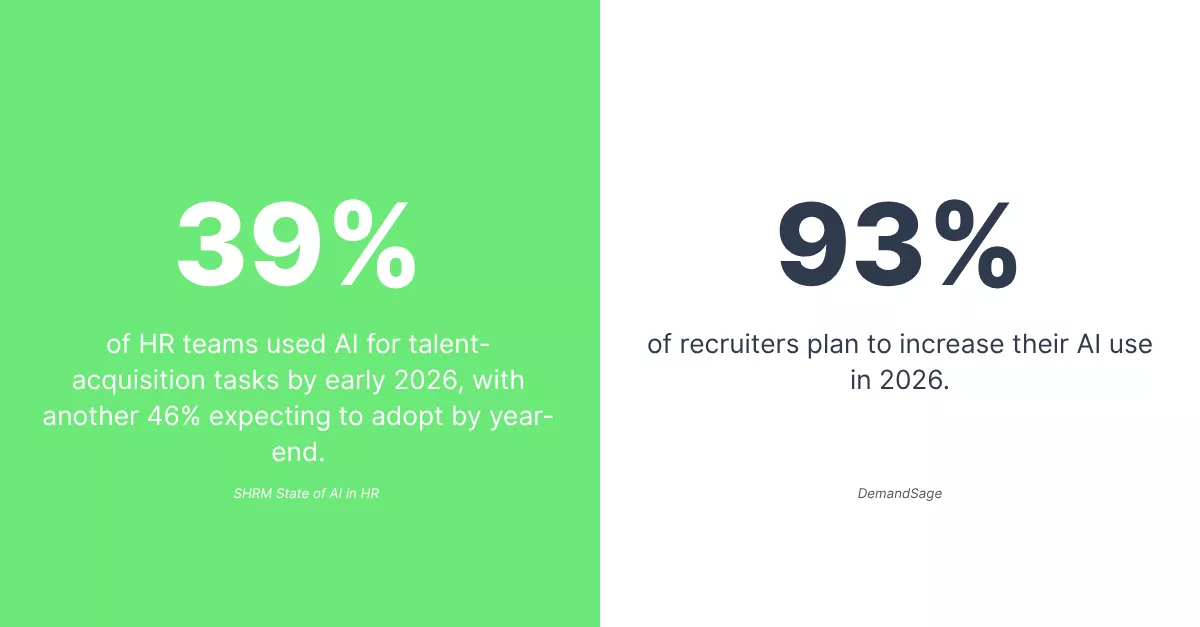
Hiring is the most widely adopted use case for AI anywhere in HR software, and the reasons are practical: writing job descriptions, screening applications, and scheduling interviews consume hours that HR teams rarely have to spare. What follows is a breakdown of where AI is actually being used today, the evidence behind it, and where the limits are.
Where AI Is Actually Being Used
Resume screening and candidate matching. AI tools can process large volumes of applications against a role's criteria far faster than manual review, surfacing a ranked shortlist instead of requiring a human to read every submission in full. This is the single most common AI use case in hiring today, and it's where most of the measurable time savings come from.
Job description generation. AI-assisted drafting tools can produce a first-pass job description from a short brief, which a hiring manager then edits, turning a blank-page task into an editing task, which tends to be faster and less prone to procrastination.
Interview scheduling. Coordinating calendars across a candidate and multiple interviewers is a genuinely tedious, low-value task that automation handles well, freeing recruiter time for higher-value work.
Chatbots for candidate FAQs. Basic candidate questions, application status, what to expect at each interview stage, general role information, can be handled by conversational tools without a recruiter fielding the same question repeatedly.
Predictive analytics. Some platforms use historical hiring data to flag which candidates, sourcing channels, or role types are statistically more likely to result in a successful, retained hire, though this use case requires enough historical data to be meaningful, and carries its own bias risks if the historical data itself reflects biased past decisions.
The Evidence
The impact shows up in the numbers. According to Gartner research cited in our breakdown of AI prompts for HR teams, AI-assisted hiring tools can cut time-to-hire by 40–50%. Separately, LinkedIn's Future of Recruiting research found that 58% of recruiters say AI reduces their administrative busywork, freeing them for higher-value candidate conversations. Recruiting also leads AI adoption across every HR software category, according to Software Advice's 2026 trends research, with an 81% utilization rate.
Where the Limits Are
That efficiency comes with a caveat every HR leader should hold onto: AI should shortlist, not decide. The strongest implementations keep a human reviewing the final shortlist and conducting the actual interview, using AI to compress the mechanical parts of the process, not to replace judgment. This "human in the loop" principle matters for two reasons beyond simple fairness: AI tools trained on historical hiring data can inherit and amplify whatever biases existed in that historical data, and candidates increasingly expect, and in some jurisdictions are legally entitled to, human review of any AI-influenced hiring decision that affects them.
Our look at AI-powered resume screening in practice walks through what that human-in-the-loop model looks like day to day, including mobile workflows that let hiring managers review AI-flagged candidates between meetings rather than at a desk.
Evaluating AI Hiring Tools
Not all AI-assisted hiring tools are built the same way, and evaluating a vendor requires asking questions that go beyond feature lists. A few worth putting directly to any vendor:
-
How is the model trained, and on what data? A tool trained primarily on one industry or role type may perform noticeably worse outside that context.
-
Can the ranking or scoring logic be explained? A tool that produces a shortlist without any visibility into why a given candidate was ranked where they were is difficult to audit for bias or defend if a hiring decision is ever challenged.
-
Has the tool been independently audited for bias? A growing number of jurisdictions require this for automated hiring tools; even where it isn't legally required, it's a reasonable baseline expectation.
-
What happens when a human disagrees with the tool's output? The workflow should make it easy, not just technically possible, for a recruiter or hiring manager to override an AI-generated ranking.
-
How is candidate data handled and retained? Especially relevant given the data-protection requirements covered in the compliance section of this guide.
Teams that skip this evaluation and adopt an AI hiring tool purely on the strength of a product demo tend to discover these gaps only after the tool is already embedded in a live hiring process, a considerably more disruptive time to find out.
AI and the Skillfishing Problem
As covered in the strategies section above, skills-based hiring's growing popularity has created a countervailing problem: candidates using AI tools to help them ace skills assessments they couldn't otherwise pass, inflating their apparent qualifications. This is pushing hiring teams toward assessments that are harder to game with outside assistance, live coding exercises with a human observer, structured problem-solving conversations, work-sample tests conducted in a monitored setting, rather than fully automated, unsupervised assessments alone.
Hiring Metrics HR Teams Should Track
Data turns a hiring process from a series of gut calls into something a team can actually improve over time. The core metrics worth tracking, what they measure, and how they're typically calculated:
|
Metric |
What It Measures |
How It's Typically Calculated |
Why It Matters |
|
Time to fill |
Days from job posting to accepted offer |
Offer acceptance date minus posting date |
Flags bottlenecks in sourcing, screening, or approvals |
|
Time to hire |
Days from a candidate's first contact to acceptance |
Offer acceptance date minus candidate's application/sourcing date |
Measures the candidate-facing speed of the process, distinct from time to fill |
|
Cost per hire |
Total hiring spend per hire |
(Sourcing + advertising + agency fees + internal recruiter time) ÷ number of hires |
Ties hiring activity to budget and ROI |
|
Applicant-to-hire ratio |
Applications received vs. hires made |
Total applicants ÷ total hires for the role |
Signals whether job postings and sourcing channels attract the right pool |
|
Offer-acceptance rate |
Share of extended offers that are accepted |
Offers accepted ÷ offers extended |
A low rate often signals compensation misalignment or a slow, frustrating process |
|
Quality of hire |
New-hire performance, retention, cultural fit over time |
Typically a composite of manager rating, 90-day/1-year retention, and performance review scores |
The clearest signal of whether the process is actually working |
|
Candidate satisfaction |
Candidate feedback on the application/interview experience |
Post-process candidate survey score |
Predicts offer-acceptance rates and protects employer brand |
|
Source of hire |
Which channel (referral, job board, LinkedIn, etc.) produced the hire |
Tracked per hire, tagged to the originating channel |
Directs sourcing budget toward what's actually working |
|
Diversity of pipeline |
Representation across the funnel by stage |
Demographic breakdown at application, interview, and offer stages |
Flags where a diverse applicant pool narrows disproportionately |
Setting Benchmarks, Not Just Tracking Numbers
A metric without a benchmark is just a number. Most teams find it more useful to track trends over time within their own organization, is time-to-fill improving quarter over quarter?, than to chase generic industry benchmarks that may not reflect their specific role types, geography, or seniority mix. That said, a first benchmark is useful to establish a baseline: pull the last four to six quarters of hiring data (even from manual records or spreadsheets) and calculate these metrics retroactively before setting improvement targets.
Common Metric Mistakes
Teams new to hiring metrics tend to make the same few mistakes. Tracking time-to-fill without tracking quality of hire optimizes for speed at the expense of fit, a role filled in ten days with someone who leaves in three months isn't actually a fast, successful hire. Comparing cost-per-hire across wildly different role types (an entry-level hire and an executive search) produces a meaningless blended number. And treating source-of-hire data as static, never revisiting which channels are working, means budget keeps flowing to channels that used to convert well but no longer do.
None of these metrics matter in isolation, the goal is tying them back to business goals rather than tracking them for their own sake. Our guide to aligning hiring metrics with business goals covers how to connect, say, a quality-of-hire metric to a broader retention or performance objective.
Hiring Software: What an ATS Actually Does
An applicant tracking system (ATS) is the software most teams use to run the hiring process end to end. At its core, it does four things:
-
Job Posting and Distribution - Pushing a single job listing out to the careers page, job boards, and social platforms simultaneously.
-
Candidate Tracking - Keeping every applicant's resume, notes, interview scores, and status in one searchable place, instead of scattered across inboxes.
-
Workflow and Collaboration - Letting hiring managers, recruiters, and interviewers share feedback and move candidates through stages without status-update emails.
-
Reporting - Surfacing the metrics above (time to fill, source of hire, and the rest) without a manual spreadsheet.
What to Look For When Choosing an ATS
Not every ATS is built the same way, and the right one depends on team size, hiring volume, and how much of the process needs to be automated versus hands-on. A few criteria worth weighing directly against each other:
-
Job Board and Career-Site Integration - Does it push postings out automatically, or does each board require a separate manual listing?
-
Customizable Workflows - Can the stages be configured to match how the team actually hires, or does the team have to adapt its process to the tool's fixed stages?
-
Candidate Communication Tools - Built-in email templates, status updates, and scheduling reduce the manual back-and-forth that slows candidates down.
-
Collaboration and Scorecards - Structured interview scorecards, shared candidate notes, and clear approval workflows for offers.
-
Reporting Depth - Whether the metrics covered above are available out of the box or require exporting data elsewhere to calculate manually.
-
Integration with the Rest of the HR Stack - Whether candidate data flows cleanly into onboarding, payroll, and the broader HRMS once a candidate is hired, or requires manual re-entry.
-
AI-Assisted Screening - Whether resume parsing and candidate matching are built in, and how transparent the tool is about how it ranks candidates.
Our rundown of what to look for in an applicant tracking system and its companion piece on how ATS platforms shape the candidate experience both go deeper into the selection criteria.
ATS and LinkedIn Integration
One underrated factor: how well the ATS plays with tools recruiters already use daily, like LinkedIn. Without integration, recruiters end up toggling between two disconnected systems, manually re-entering candidate data and losing track of which insights live where. Our look at how ATS platforms integrate with LinkedIn covers why disconnected systems create duplicate work and where integration actually saves recruiter time.
Implementation Considerations
Rolling out a new ATS is its own small project, separate from choosing one. Data migration from a previous system or from spreadsheets needs planning, historical candidate data is often messier than it looks until someone tries to import it. Hiring managers who aren't full-time recruiters need a short, focused training session rather than a full system walkthrough; most only need to know how to review a shortlist, leave interview feedback, and approve a stage move. And a pilot period on one or two open roles, before rolling the system out to every hiring manager simultaneously, surfaces workflow mismatches while they're still cheap to fix.
For teams evaluating a full applicant tracking system rather than piecing tools together, our ATS and hiring module covers job posting, candidate grading, and structured workflows in one platform, worth a look alongside whatever else is on the shortlist. We also breaks down how it supports recruiters specifically, from candidate sourcing through the handoff to onboarding.
Measuring the Return on a New ATS
Justifying the cost of a new or upgraded ATS is easier with a specific before-and-after comparison rather than a general sense that "the old system was slow." Worth calculating explicitly, using the metrics defined earlier in this guide: recruiter hours spent on manual, repetitive tasks (screening, scheduling, status updates) before versus after; time-to-fill and time-to-hire before versus after; and candidate satisfaction scores before versus after, if that data is available. A tool that saves a recruiter several hours a week on manual screening alone often pays for itself well before accounting for faster time-to-fill or improved candidate experience, but only if someone actually measures the baseline before switching, rather than relying on impression alone once the new system is live.
It's also worth tracking adoption, not just capability: a feature-rich ATS that hiring managers avoid using, falling back to email and spreadsheets out of habit, delivers none of its theoretical ROI. A short adoption check a few months after rollout (are hiring managers actually leaving structured feedback in the system, or still sending it by email) catches this early, while it's still an easy habit to correct.
Common Hiring Challenges (and How to Fix Them)
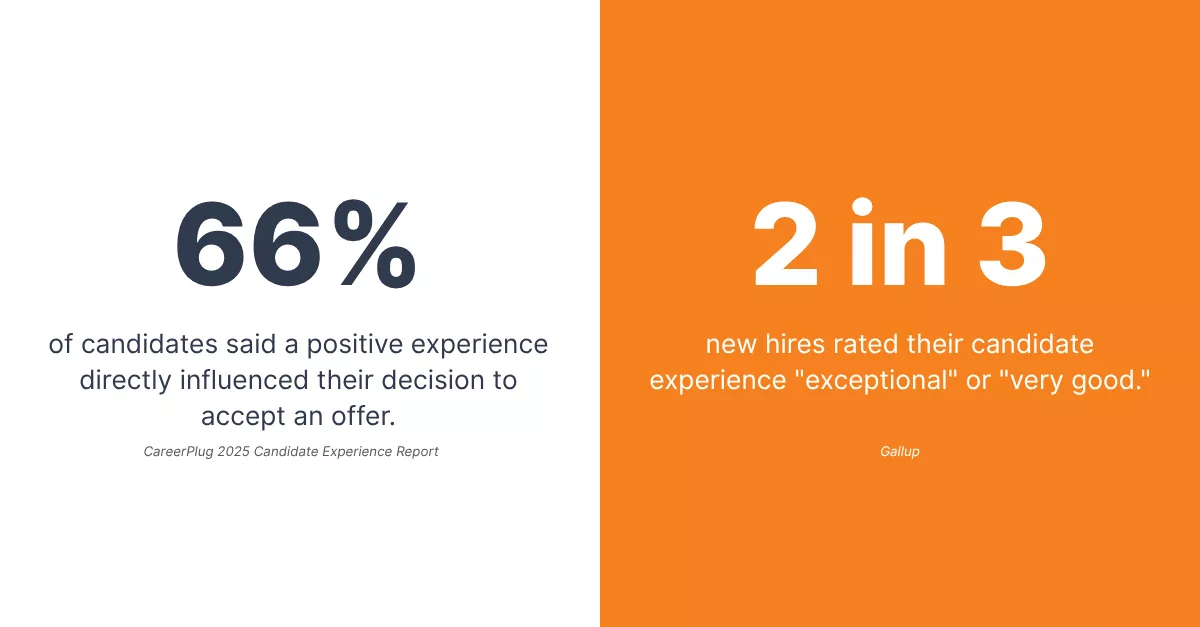
Candidates drop off mid-process. Long gaps between interview stages, or radio silence after an application, push strong candidates toward competitors who move faster. This is often the single biggest source of lost offers, not losing a negotiation, but losing the candidate before an offer is even extended. Fix, set, and communicate a clear timeline at every stage, and treat any gap longer than a week without an update as a process failure worth investigating.
Interviews are inconsistent across candidates. Without a shared rubric, different interviewers evaluate the same role on different criteria, making it nearly impossible to compare candidates fairly at the selection stage. Fix: standardize interview questions and scoring before the first candidate is scheduled, and require every interviewer to submit written scores against the same rubric.
Sourcing channels aren't actually working. Posting to the same three job boards out of habit, without checking source-of-hire data, wastes budget on channels that stopped converting long ago. Fix: review source-of-hire metrics quarterly and reallocate spend toward what's converting, even if it means dropping a channel the team has used for years.
Bias creeps into evaluation. Gut-feel decisions, unstructured interviews, and inconsistent scoring all leave room for unconscious bias to shape who advances and who doesn't, often invisibly, without any single decision looking obviously unfair. Fix: structured interviews and standardized scorecards, applied the same way for every candidate, plus periodic review of pipeline diversity data by stage.
No one owns the data. When hiring metrics live in scattered spreadsheets, or nowhere at all, it's impossible to know what's actually improving versus what just feels better anecdotally. Fix: centralize tracking in a single system connected to the ATS, with one person accountable for reviewing it regularly.
Budget constraints limit sourcing options. Smaller teams and tighter budgets often can't afford premium job board placements, agency fees, or extensive employer-branding campaigns. Fix: lean harder into the lowest-cost, highest-signal channels, employee referrals, internal mobility, and an active presence in role-specific online communities, rather than trying to compete dollar-for-dollar on paid channels.
Passive candidates are hard to reach. The strongest candidates for competitive roles are often not actively job-searching, and a standard job posting won't reach them at all. Fix: proactive outbound sourcing and a talent pipeline maintained before roles open, covered in more depth later in this guide.
Remote hiring adds logistical complexity. Coordinating interviews across time zones, verifying identity and eligibility to work remotely, and evaluating culture fit without an in-person meeting all complicate a process built around in-office assumptions. Fix: covered in its own dedicated section below.
Hiring managers treat the process as someone else's job. In organizations where hiring managers see recruiting as purely the recruiter's responsibility, they tend to disengage from the parts of the process that most need their input, defining accurate criteria during workforce planning, giving timely interview feedback, and making a prompt selection decision. Fix: make hiring-manager responsibilities explicit and visible, ideally with their own timeliness metrics (such as time to submit interview feedback) tracked alongside the recruiter's.
Good candidates get lost between stages. Even with a capable ATS, a candidate can sit unnoticed at a stage transition if no one owns moving them forward, particularly in processes with several approval layers. Fix: assign explicit ownership for every stage transition, not just every stage, and set a maximum number of days a candidate can sit at any one point before it's flagged for review.
Hiring for Different Company Sizes
Startups
Early-stage companies often hire without a dedicated recruiter at all, a founder or a generalist handles every open role alongside a dozen other responsibilities. Speed and flexibility matter more than process rigor at this stage, but even a lightweight structure (a shared candidate tracker, a consistent set of interview questions) pays off quickly once hiring volume passes a handful of roles a quarter.
Small and Mid-Sized Businesses
Small and mid-sized businesses typically hire less frequently and with fewer dedicated staff, which makes automation (job posting, resume screening) proportionally more valuable, it replaces work that would otherwise fall on a generalist HR team wearing multiple hats. An ATS built for lighter hiring volume, with straightforward setup and no need for a dedicated administrator, tends to be a better fit than an enterprise-grade platform with more configuration overhead than the team needs.
Mid-Market Organizations
Once an organization hires consistently across multiple departments, hiring typically needs its own dedicated owner, a recruiter or small team, and a more formalized process than a single generalist can maintain alone. This is also usually the point where hiring metrics move from "nice to have" to genuinely necessary, since a growing organization can no longer track every open role informally.
Enterprise Organizations
Enterprise organizations hire at higher volume, often across multiple regions and compliance regimes, and need an ATS that scales, structured workflows, role-based permissions, and reporting that rolls up across departments and geographies. Enterprise hiring processes also tend to involve more stakeholders per decision (multiple approval layers, cross-functional interview panels), which makes clear workflow automation more important, not less, without it, a multi-stakeholder process becomes a multi-stakeholder bottleneck.
The core process stays the same at every size; what changes is how much of it needs to run on autopilot versus a human touch, and how many people need visibility into where a given candidate stands.
Compliance and Legal Considerations by Region
Hiring compliance requirements vary significantly by region, and a hiring process built entirely around one jurisdiction's rules can create real legal exposure when applied elsewhere without adjustment. This section is a starting orientation, not legal advice, organizations hiring across multiple regions should confirm specifics with local employment counsel.
United States
US hiring is shaped heavily by anti-discrimination law, Title VII, the ADA, and age discrimination protections all restrict what can be asked or considered during the hiring process. A growing number of states and cities also regulate salary-range disclosure in job postings and restrict asking candidates about salary history. AI-assisted hiring tools face increasing scrutiny too: several jurisdictions now require bias audits or disclosure when automated tools are used to screen or rank candidates.
United Kingdom
UK hiring operates under the Equality Act, which prohibits discrimination based on a defined set of protected characteristics throughout the hiring process, not just at the final decision. Right-to-work verification is a mandatory step for every hire, and increasing regulatory attention is being paid to how AI hiring tools are used, particularly around transparency and candidates' ability to request human review of an automated decision.
European Union
EU hiring sits inside the GDPR's data-protection framework, which affects how long candidate data can be retained after a process closes, what candidates must be told about how their data is used, and increasingly, how AI-assisted hiring decisions must be explainable and subject to human review under emerging AI-specific regulation. Country-level employment law within the EU also varies considerably, a hiring process compliant in one member state isn't automatically compliant in another.
Middle East (GCC)
Hiring across the Gulf Cooperation Council region typically involves localization requirements, quotas or incentives for hiring local nationals alongside expatriate workers, that vary by country and industry. Work visa and sponsorship processes also add a layer to the hiring timeline that doesn't exist in fully domestic hiring, and should be planned for explicitly rather than treated as an afterthought once an offer is accepted.
Asia-Pacific
APAC hiring compliance varies widely country to country, with different rules around employment contracts, probation periods, and termination that indirectly shape hiring decisions, a market with a long, difficult termination process, for instance, tends to make the initial hiring decision even more consequential. Data-protection regimes across the region are also tightening, with several markets introducing GDPR-influenced rules around candidate data handling.
A Practical Starting Point
For organizations hiring across regions, the most common practical failure isn't ignorance of the law, it's applying a single hiring process, template, or interview question set globally without regional review. A job posting compliant in one market can create liability in another simply through what it asks candidates to disclose. Building regional variation into hiring templates from the start is considerably easier than retrofitting compliance after an issue surfaces.
Inclusive and Diverse Hiring Practices
Inclusive hiring isn't a separate track layered onto the process described above, it's largely the same structured process, applied consistently, with a few specific additions.
Writing Inclusive Job Postings
Job postings often contain language that unintentionally discourages qualified candidates from applying, gendered wording, inflated "must-have" lists that screen out otherwise strong candidates, or jargon that assumes a specific educational or career background. Reviewing postings specifically for this kind of language, separate from proofreading for typos, catches issues a single writer working alone tends to miss.
Structured Interviews as a Bias Reduction Tool
As covered earlier, structured interviews, the same questions and rubric for every candidate, are one of the most effective, well-evidenced tools available for reducing bias in hiring decisions. Unstructured conversations leave far more room for an interviewer's unconscious preferences to shape the outcome, even with good intentions.
Diverse Interview Panels
Involving more than one interviewer, from more than one background, in the evaluation of a given candidate reduces the influence of any single person's blind spots on the final decision. This matters most at the stages where the applicant pool is narrowing fastest, the initial screen and the final selection, since that's where a single evaluator's bias has the most leverage over the outcome.
Tracking Pipeline Diversity, Not Just Outcomes
Reviewing representation only at the final hire stage misses where a diverse pool actually narrows. Tracking diversity by stage, application, interview, offer, shows whether a diverse applicant pool is dropping off disproportionately at a specific point in the process (for instance, at the resume-screen stage), which points directly at where to intervene.
Accessible Hiring Processes
Accessibility considerations, alternative formats for job postings and assessments, accommodations for interviews, accessible application platforms, aren't a compliance checkbox alone; they directly affect how many qualified candidates with disabilities make it through a process that wasn't designed with them in mind. Building accommodation requests into the standard process, rather than treating them as one-off exceptions handled ad hoc, makes the process more consistent and less likely to create friction for candidates who need it.
Remote and Hybrid Hiring
Hiring for remote and hybrid roles introduces logistics that an in-office-first process doesn't need to account for.
Interviewing Across Time Zones
Coordinating interview panels across multiple time zones is a genuinely harder scheduling problem than single-office hiring, and it tends to get worse, not better, as a hiring process scales without deliberate planning. Building time-zone flexibility into the interview process from the start, asynchronous take-home assessments where appropriate, recorded video responses to standard questions, wider interview-availability windows, reduces the scheduling bottleneck considerably.
Evaluating Fit Without an Office
Culture fit is harder to assess without shared physical space, and teams sometimes overcorrect by either ignoring it entirely or leaning too heavily on vague, hard-to-defend impressions. A more reliable approach treats "fit" as a specific, structured set of questions about how a candidate has handled the actual demands of remote work, asynchronous communication, self-directed prioritization, working across time zones, rather than an unstructured gut check.
Verifying Identity and Work Eligibility
Remote hiring, especially across borders, raises identity-verification and work-eligibility questions that in-person, single-country hiring doesn't. This is also where candidate fraud has become a genuine, growing problem, fabricated candidates, sometimes using AI-generated interview responses or deepfake video, attempting to pass through fully remote, fully automated hiring processes undetected. At least one verification touchpoint that isn't fully automated, a live video interview with a real person, a document check, is worth preserving even in an otherwise highly automated process.
Compensation and Legal Complexity
Hiring someone in a different country or state than the organization's home jurisdiction can trigger local employment law, tax, and compliance obligations that don't apply to domestic hiring, covered in more depth in the compliance section above. Many organizations use an Employer of Record or similar structure specifically to handle this complexity for roles outside their core operating jurisdictions, rather than attempting to navigate every local requirement in-house.
Building a Talent Pipeline Before You Need One
Reactive hiring, starting a search from zero the moment a role opens, is slower and more expensive than proactive pipelining, where a pool of warm candidates already exists before a specific vacancy arises.
What a Talent Pipeline Actually Is
A talent pipeline is a maintained pool of past applicants, previously sourced candidates, and expressed-interest contacts, organized so that when a role opens, the hiring team isn't starting from a blank search. It's built continuously, not assembled in a scramble once a position is approved.
Sources for a Pipeline
Past applicants who weren't hired. A strong candidate for one role who didn't get selected is often still a strong candidate for a similar role later, provided their information and evaluation notes are retained and easily searchable, rather than lost once a requisition closes.
Proactively sourced candidates. Recruiters reaching out to potential candidates before a specific role is open, building relationships and interest ahead of need, shortens the search dramatically once a vacancy does arise.
Alumni and boomerang employees. Former employees who left on good terms are often underused as a source of future hires; they already know the organization, and rehiring a known strong performer carries far less risk than a fully external hire.
Referral networks. Employees' professional networks represent a continuously available, low-cost sourcing channel that a formal referral program keeps active, rather than relying on ad hoc, occasional referrals.
Keeping a Pipeline Warm
A pipeline that isn't maintained decays quickly, candidates take other roles, contact information goes stale, and interest cools. Periodic, low-pressure touchpoints (a relevant content share, a check-in with no immediate ask attached) keep a pipeline genuinely warm rather than becoming an outdated list that looks useful but isn't, once someone actually tries to use it.
Hiring by Industry: What Changes
The seven-stage process holds across industries, but what gets emphasized, and what tends to go wrong, shifts considerably by sector.
Technology
Tech hiring is typically the most competitive for specialized skills, and skills-based, hands-on assessment tends to matter more here than almost anywhere else, a strong resume is a weak substitute for a demonstrated ability to solve the kind of problems the role actually involves. Passive-candidate sourcing carries disproportionate weight, since the strongest engineers, designers, and product specialists are frequently employed and not actively applying anywhere.
Healthcare
Healthcare hiring layers licensing and credential verification on top of the standard process, a step that can't be skipped or rushed, and that often becomes the real bottleneck in time-to-fill rather than sourcing or interviewing. Burnout-driven turnover in many healthcare roles also makes proactive pipelining and referral programs disproportionately valuable, since the talent pool for many clinical roles is both specialized and finite within a given region.
Retail and Hospitality
High-volume, often seasonal hiring is the norm, which shifts the emphasis toward speed and process efficiency over deep individualized evaluation for every role. Structured, fast-moving screening, sometimes compressed into a single combined interview and decision stage, tends to matter more here than the multi-stage panel processes common in other industries, simply because the volume doesn't allow for it.
Manufacturing and Logistics
These sectors often combine a tight local labor market for skilled trades with genuinely high-volume hiring for other roles, requiring two different hiring motions running in parallel, a slower, relationship-driven process for specialized technical roles, and a faster, higher-throughput process for general labor positions. Physical assessment and safety-certification verification also add steps that purely office-based hiring processes don't need.
Professional Services
Firms hiring for client-facing, credential-heavy roles (consulting, legal, accounting) tend to weight structured case interviews or technical assessments heavily, alongside a longer, more relationship-driven interview process than is typical elsewhere, since client trust in the individual is often central to the role itself, not just their technical competence.
Budgeting for Hiring
Hiring budgets are often built reactively, approved role by role, without a clear picture of where the money actually goes. A more deliberate approach breaks spend into a few core categories and reviews the allocation periodically against what's actually producing hires.
Where the Budget Typically Goes
-
Job Board and Advertising Spend - Paid postings, sponsored listings, and targeted social advertising for open roles.
-
ATS and Hiring Software - The ongoing cost of the platform running the hiring process itself.
-
Agency and Contingency Search Fees - Typically the largest single line item per hire when used, reserved for roles that are hard to fill internally.
-
Referral Bonuses - Usually a small, fixed cost per successful referral hire, and often the best return on spend in the entire budget.
-
Internal Recruiter Time - Rarely tracked as an explicit cost, but a meaningful one once calculated against cost-per-hire.
-
Employer Branding and Content - Career-site development, recruitment marketing content, and any dedicated employer-brand campaigns.
Build vs. Buy Decisions
A recurring budget question is whether to build internal recruiting capacity (in-house recruiters, an owned ATS) or buy it externally (agencies, contingency search firms) for a given hiring need. As a rough guide: predictable, recurring hiring volume tends to favor building internal capacity, since the fixed cost of an in-house recruiter or platform amortizes across many hires. Rare, highly specialized, or urgent searches tend to favor buying external expertise for that specific search, since building internal capability for something that happens once a year rarely pays for itself.
Tying Budget to Source-of-Hire Data
The most common budgeting mistake is holding spend steady year over year without revisiting which channels actually produced hires. Reviewing source-of-hire data (covered in the metrics section above) alongside the budget each planning cycle, and shifting spend away from channels that have stopped converting, is a straightforward exercise that most organizations skip simply because it isn't scheduled as a recurring task.
Structuring a Hiring Team
Who does what across the hiring process varies by organization size, but a few roles recur consistently once hiring volume passes what a single generalist can manage alone.
Core Roles
Recruiter - Owns the day-to-day execution of open roles, sourcing, screening, coordinating interviews, and managing candidate communication. In smaller organizations, this role often absorbs sourcing and coordination as well; in larger ones, those tend to split into separate functions.
- Sourcer - Focused specifically on proactive, outbound candidate identification, particularly valuable for hard-to-fill or senior roles where waiting for inbound applications alone isn't a viable strategy. Not every organization has a dedicated sourcer; smaller teams fold this responsibility into the recruiter role.
- Hiring Manager - Owns the final decision for their team's open roles, defining the role's requirements during workforce planning, participating in interviews, and making the ultimate selection call. The hiring manager isn't typically involved in the administrative mechanics of the process, but their engagement at the criteria-setting and decision stages is essential to a process that produces good hires.
- Interview Panel Members - Employees brought in to evaluate candidates against specific competencies, usually using the structured scorecards described earlier in this guide. Panel members need enough training to apply a rubric consistently, an untrained panelist tends to default to gut feeling regardless of how good the scorecard is.
- Recruiting Coordinator - Handles scheduling, logistics, and candidate communication, a role that becomes disproportionately valuable at higher hiring volumes, where the coordination overhead alone can become a full-time job.
- Talent Acquisition Leader - Owns the strategic layer described earlier in this guide, employer branding, pipeline-building, hiring technology decisions, and the metrics program, as distinct from the tactical, role-by-role work a recruiter handles.
A Simple Responsibility Split
For organizations without a formal RACI process, a lighter version works well enough for hiring specifically:
|
Stage |
Primary Owner |
Consulted |
Informed |
|
Workforce planning |
Hiring manager |
Recruiter, finance |
Talent acquisition leader |
|
Job posting and sourcing |
Recruiter |
Hiring manager |
- |
|
Screening |
Recruiter |
Hiring manager |
- |
|
Interviewing |
Recruiter (coordination), panel (evaluation) |
Hiring manager |
- |
|
Selection |
Hiring manager |
Panel, recruiter |
Talent acquisition leader |
|
Offer |
Recruiter (execution) |
Hiring manager, finance |
- |
|
Onboarding handoff |
Recruiter |
Hiring manager |
Onboarding team |
When to Add Headcount to the Hiring Function
A rough signal worth tracking: once a single recruiter is consistently managing more open roles at a time than they can give genuine attention to, commonly cited around fifteen to twenty concurrent requisitions, though this varies by role complexity, quality and candidate experience tend to degrade even if the recruiter is skilled and works hard. This is a more reliable trigger for adding hiring-team headcount than an arbitrary company size or revenue milestone.
Templates and Checklists
The following are meant as practical starting points a hiring team can adapt, not rigid formats to follow exactly as written.
Job Description Template
-
Role Title - Clear and searchable; avoid internal-only titles candidates wouldn't search for.
-
Team and Reporting Line - Who the role reports to and where it sits in the org.
-
Core Responsibilities - 4-6 bullet points describing what the role actually does day to day.
-
Must-Have Qualifications - Kept genuinely essential; an inflated list screens out otherwise strong candidates.
-
Nice-to-Have Qualifications - Clearly separated from must-haves, so candidates without every item still feel encouraged to apply.
-
Compensation Range - Increasingly expected, and required by law in a growing number of jurisdictions.
-
Company and Team Context - A few sentences on what the team does and why the role matters, not generic company boilerplate.
-
Application Instructions - What to expect next, and a realistic timeline.
Structured Interview Scorecard
-
Role and Interview Stage - Which stage this scorecard applies to.
-
Core Competencies Being Assessed - 3-5 specific, role-relevant competencies, not a generic list reused across every role.
-
Standard Questions Per Competency - The same questions for every candidate at this stage.
-
Scoring Scale - A consistent numeric or descriptive scale (e.g., 1-4, "does not meet / meets / exceeds") applied the same way by every interviewer.
-
Space for Specific Evidence - Notes tied to actual candidate responses, not general impressions, to support the score if the decision is ever reviewed.
-
Overall Recommendation - Advance, hold, or reject, with the reasoning documented.
Offer-Stage Checklist
-
Compensation confirmed against the pre-approved band for the role.
-
Internal approvals secured before the offer is extended, not during negotiation.
-
Start date, remote-work terms, and any other negotiated conditions documented in writing.
-
Background check and reference process initiated, with a clear timeline communicated to the candidate.
-
Rejection communications sent promptly to other finalist candidates, with respectful, specific-enough feedback where feasible.
-
Handoff package prepared for onboarding: candidate data, documentation, and any context gathered during the process.
30-Day Hiring Process Health Check
A short, periodic self-audit worth running roughly every quarter:
-
Are time-to-fill and time-to-hire trending in the right direction over the last two quarters?
-
Is offer-acceptance rate stable, or declining in a way that suggests a compensation or process problem?
-
Which sourcing channels actually produced hires in the last quarter, and does budget allocation match that?
-
Are interview scorecards being completed consistently, or skipped under time pressure?
-
Where in the pipeline is diversity narrowing most, if diversity data is being tracked?
-
Is candidate feedback (formal survey or informal signals) surfacing any recurring friction points?
Glossary of Common Hiring Terms
Applicant Tracking System (ATS) - Software used to manage job postings, track candidates, and run the hiring workflow from posting through offer.
Candidate Experience - How a candidate perceives and is treated throughout the hiring process, from application to final decision.
Cost Per Hire - Total hiring spend divided by the number of hires made, used to measure hiring efficiency and budget ROI.
Employer Branding - How an organization presents itself to potential candidates, shaping who applies before a recruiter reviews a single resume.
Employer of Record (EOR) - A third-party organization that formally employs a worker on a company's behalf, typically used for hiring across borders without establishing a local legal entity.
Inbound Sourcing - Candidates finding and applying to a posted opening on their own, as opposed to being proactively contacted.
Offer-Acceptance Rate - The share of extended job offers that candidates accept, used as a signal of compensation competitiveness and process quality.
Outbound Sourcing - A recruiter proactively identifying and reaching out to candidates, rather than waiting for applications.
Passive Candidate - Someone who isn't actively job-searching but might consider a specific, compelling opportunity if approached.
Quality of Hire - A composite measure of a new hire's performance, retention, and fit over time, generally considered the clearest indicator of hiring-process effectiveness.
Skills-Based Hiring - Evaluating candidates primarily against the specific skills a role requires, rather than relying mainly on job titles, years of experience, or degrees.
Skillfishing - Candidates overstating or misrepresenting their skills, sometimes with AI assistance, to pass skills-based assessments.
Source of Hire - The channel (referral, job board, LinkedIn, agency, etc.) that produced a given hire, tracked to inform sourcing budget decisions.
Structured Interview - An interview format using the same core questions and a documented scoring rubric for every candidate in a given role.
Talent Acquisition - The broader, ongoing strategy behind hiring, including employer branding, workforce planning, and pipeline-building, as distinct from the tactical work of filling a single role.
Talent Pipeline - A maintained pool of past applicants, sourced candidates, and expressed-interest contacts a team can draw on when a role opens.
Time to Fill - The number of days from a job posting going live to a candidate accepting an offer.
Time to Hire - The number of days from a candidate's first contact with the process to their acceptance, measuring speed from the candidate's perspective.
Key Takeaways
A strong hiring process combines several things working together: a clear, repeatable set of stages; a strategy, skills-based evaluation, structured interviews, employer branding, proactive pipelining, built for how candidates actually search and apply in 2026; metrics that connect hiring activity back to business outcomes, not just headcount; and deliberate attention to compliance, inclusion, and the specific logistics of remote hiring, rather than treating those as afterthoughts layered onto a process designed without them in mind.
AI is changing how fast teams move through that process, but it works best as a shortlisting tool, not a decision-maker, the organizations getting the most value from it are the ones that kept a human in the loop rather than removing one. Ultimately, recruitment succeeds when process, strategy, and technology reinforce each other rather than operating in isolation, and when the process is treated as something to measure and improve continuously rather than something built once and left alone.
For broader context on where hiring fits within the rest of HR operations, our overview of HR management best practices is a useful next read.