Q4 readiness reduces to three measurable questions: how fast hiring moves, how far in advance shifts are published, and how completely year-end regulatory obligations are documented. The current benchmarks are specific and public. Median time-to-fill for nonexecutive roles now sits at 39 calendar days, according to SHRM's 2026 benchmarking data drawn from more than 4,600 organizations. Fourteen days is the advance-notice standard written into nearly every fair workweek ordinance in the United States. And the U.S. Department of Labor's Wage and Hour Division recovered more than $259 million in back wages in fiscal year 2025, its highest total since 2019. Organizations that measure themselves against those three figures before October enter the quarter prepared. Those that do not tend to discover the gaps in December, when correction is most expensive and least discreet.
What Does Q4 Readiness Actually Measure?
The final quarter concentrates workload in a way no other stretch of the calendar does. Seasonal headcount arrives, shift demand spikes and then collapses, and the statutory filing calendar for the following January and February is effectively locked in by decisions made in October and November.
Readiness is therefore not a state of mind. It is a set of numbers that can be pulled from an HR system and compared against external reference points. Three benchmark families matter most:
-
Recruitment Velocity - time-to-fill, cost-per-hire, and requisition load per recruiter
-
Schedule Stability - advance notice, change frequency, and premium pay exposure
-
Regulatory Documentation - filing readiness, wage-floor updates, and verification records
Each has a defensible external benchmark. Each is also measurable internally using data most HR teams already collect but rarely assemble in one place. The gap between those two conditions, data held versus data usable, is where most Q4 failures originate.
Benchmark One: Hiring Velocity and Seasonal Demand
The seasonal labor picture has shifted structurally, and Q4 planning assumptions built on pre-2023 patterns now overstate the market.
The Demand Side Has Thinned
Challenger, Gray & Christmas tracked 372,520 announced seasonal positions in the fourth quarter of 2025, the lowest figure since the firm began tracking seasonal plans in 2012. Retail alone had added 543,100 positions in Q4 2024. The contraction is attributed to automation, greater reliance on existing staff, and caution about consumer demand rather than to a single cyclical dip.
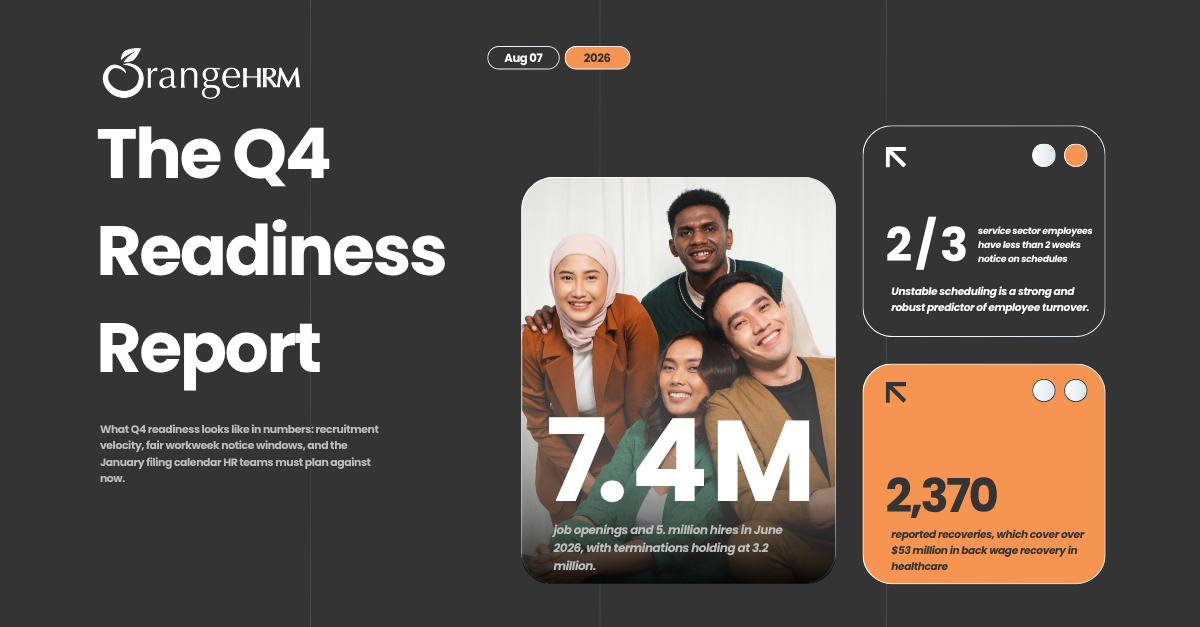
Broader labor turnover data points the same direction. The Bureau of Labor Statistics reported 7.4 million job openings and 5.3 million hires in June 2026, with quits holding at 3.2 million. Earlier in the year, the hires rate fell to 3.1 percent, matching the lowest reading since April 2020. A thinner seasonal market does not make recruitment easier; it makes it more competitive for the specific shifts that are hardest to cover.
The Internal Benchmarks To Measure Against
SHRM's 2026 data provides the clearest reference set. Time-to-fill for nonexecutive roles has fallen to a median of 39 calendar days. The share of nonexecutive positions filled externally rose from 93 percent to 97 percent. Extra-large organizations recorded a 67 percent jump in median requisitions per recruiter. And more than two in three organizations still reported difficulty filling open roles.
Read together, these figures describe recruiting teams carrying heavier caseloads while moving faster and relying more on external candidates. The practical Q4 benchmark set looks like this:
|
Metric |
Reference point |
Source |
|
Time-to-fill, nonexecutive |
39 calendar days (median) |
SHRM 2026 |
|
Cost-per-hire, nonexecutive |
$5,475 |
SHRM 2025 |
|
Positions filled externally |
97 percent |
SHRM 2026 |
|
Requisition load per recruiter |
Rising sharply at scale |
SHRM 2026 |
A team requiring 55 days to fill frontline roles has a structural problem that a November push will not solve. Working backward from a peak-trading start date at a 39-day median means requisitions open in late summer, not mid-autumn. Seasonal hiring plans built without that arithmetic tend to convert into overtime spend instead of headcount.
Benchmark Two: Advance Notice and Shift Stability
Fourteen days is the number to plan against. Nearly every U.S. fair workweek ordinance has converged on that window, and it now functions as a de facto national standard even in jurisdictions with no such requirement.
The Regulatory Map Is Uneven and Still Moving
As of 2026, eleven U.S. jurisdictions enforce predictive scheduling or fair workweek rules. Oregon remains the only state with a statewide mandate. The other ten are city or county ordinances: New York City, San Francisco, Seattle, Philadelphia, Chicago, Emeryville, Berkeley, Evanston, Los Angeles, and unincorporated Los Angeles County, which took effect on July 1, 2025.
Movement runs in both directions. Eleven states, including Florida, Georgia, Michigan, Ohio, and Tennessee, have passed preemption laws barring local governments from adopting such ordinances at all. A multi-site employer can therefore operate three locations under three entirely different sets of obligations, with no realistic prospect of a single national policy satisfying all of them.
Most ordinances share the same structure: written schedules issued in advance, premium pay when a posted shift changes inside the notice window, a rest period between shifts, and a right of first refusal on newly available hours. The variation sits in the thresholds and the premium amounts, which is precisely why manual tracking breaks down across jurisdictions.
Stability Is a Retention Variable, Not Only a Legal One
Research from Harvard's Shift Project has consistently found that around two-thirds of service-sector workers receive schedules with less than two weeks' notice, and roughly a third receive less than one week. A longitudinal study of hourly retail and food service workers found that exposure to unstable scheduling is a strong and robust predictor of turnover, mediated by work-life conflict and job dissatisfaction.
That finding matters commercially. Every seasonal worker lost in week three of December triggers a replacement cycle at the moment when the external candidate pool is thinnest and cost-per-hire is highest. Schedule predictability is, in effect, a retention lever that costs nothing to pull.
What Noncompliance Costs at Scale
On December 1, 2025, New York City announced a $38.9 million settlement with Starbucks, the largest worker-protection settlement in the city's history. A multi-year investigation by the Department of Consumer and Worker Protection identified more than 500,000 violations of the Fair Workweek Law across over 300 locations, resulting in $35.5 million in restitution to more than 15,000 workers plus $3.4 million in penalties and costs.
The underlying requirements are not exotic. New York City obliges covered fast food employers to issue schedules 14 days ahead, pay premiums for changes, obtain written consent and a $100 premium for back-to-back closing and opening shifts, and offer newly available shifts to existing staff before hiring new workers. What produced half a million violations was not a policy decision but an accumulation of small, undocumented changes across hundreds of sites over several years.
Benchmark Three: The Year-End Regulatory Calendar
The compliance load that lands in January and February is determined by data captured in October, November, and December. Four items dominate.
Affordable Care Act Reporting
Applicable Large Employers must furnish Form 1095-C to employees and file Forms 1094-C and 1095-C with the IRS. Per the IRS instructions, the furnishing deadline is automatically extended 30 days from January 31, and no further extensions are granted. Electronic filing is due March 31, and any employer submitting 10 or more information returns in aggregate must file electronically. An alternative furnishing method now permits posting a notice of availability rather than mailing every form, though California, New Jersey, and Rhode Island maintain separate requirements.
Full-time status determinations for seasonal and variable-hour staff flow directly into these filings. Hours data that is incomplete in November becomes a reporting defect in March.
Wage Floors Resetting January 1
The National Employment Law Project counted 68 cities, counties, and states raising minimum wages on January 1, 2026, with 26 more scheduled later that year. California has confirmed a statewide increase to $17.40 effective January 1, 2027, and Michigan is scheduled to reach $15.00 on the same date. Pay tables, overtime calculations, and offer letters issued in Q4 for January start dates all need to reflect the incoming rate rather than the current one.
Employment Eligibility Verification
Worksite enforcement has intensified. Legal analysts report that ICE has narrowed the definition of correctable technical I-9 violations, reclassifying a number of errors previously treated as curable as substantive violations subject to immediate penalty, alongside significantly expanded federal enforcement funding. High-volume seasonal intake is precisely the condition under which verification errors multiply, because the same documentation step is repeated hundreds of times under time pressure.
Wage and Hour Exposure
The Wage and Hour Division's fiscal year 2025 recovery of $259 million covered 176,957 employees, averaging $1,465 per worker. Sector concentration is instructive: food services accounted for 4,088 resolved violations and more than $42 million recovered, while healthcare produced 2,370 resolved violations and over $53 million. Both are sectors built on seasonal intake and shift-based staffing, which is to say, both carry the exact risk profile Q4 amplifies.
Where the Three Benchmarks Converge
These are not three separate problems. They are three views of the same underlying record, who was brought on, when they actually worked, and what they were owed.
A seasonal worker onboarded in November generates a verification record, an hours history that determines benefits eligibility, a shift pattern governed by local advance-notice rules, and a wage calculation subject to a January rate change. When those four data points live in four different systems, reconciliation happens manually in February, under deadline pressure, using exports that have already drifted apart from one another.
Fragmentation is the common failure mode behind every benchmark discussed above. Slow hiring is usually a workflow visibility problem. Fair workweek violations are usually a change-logging problem. Late or defective filings are usually a data-completeness problem. None of them is primarily a policy problem, which is why writing a better policy rarely fixes them.
The Audit-Readiness Test
One diagnostic exposes the gap quickly. For a single seasonal worker taken on last November, how long would it take to produce a complete record: the verification documents collected, every shift published and every subsequent amendment, total hours by week, and the pay rate applied to each of those weeks?
Organizations able to answer within minutes have functioning compliance infrastructure. Organizations requiring several days of manual assembly have a compliance exposure that no volume of written policy offsets, because the weakness sits in retrieval rather than in intent, and regulators assess what can be evidenced, not what was intended.
That test also scales in exactly the way Q4 does. One worker is trivial. Four hundred seasonal workers spread across twelve locations, three scheduling jurisdictions, and two pay-rate changes is not, unless retrieval has been automated in advance.
Closing the Gap With a Single System of Record
The practical response is consolidation rather than additional process. An integrated HRMS keeps recruitment, scheduling, time capture, and documentation on one record, so that a change in one place propagates everywhere it is relevant.
OrangeHRM is built around that model. Our Recruitment module handles postings, candidate tracking, and interview coordination, with AI Job Fit Scoring applying consistent criteria to every applicant. Preboarding and Onboarding automate document collection before day one, which matters most when intake volume is at its peak. The Roster module manages shift planning and staffing optimization, and feeds directly into Time & Attendance so that published shifts, worked hours, and pay policies reconcile continuously rather than at year-end. Reporting & Analytics then exposes the metrics, time-to-fill, hours by employee, schedule change frequency, that the benchmarks above require.
The Advanced edition, which includes Roster, Onboarding, and Citra AI, is available on a 30-day trial. Citra, the built-in AI assistant, resolves routine employee queries: leave balances, who is out on a given day, shift details, through chat, absorbing a category of inbound volume that expands sharply once seasonal headcount arrives.
The Q4 Readiness Checklist
A defensible readiness review covers eight items:
-
Time-to-fill measured against the 39-day median, with requisitions opened accordingly
-
Advance-notice window confirmed per jurisdiction, defaulting to 14 days where no rule applies
-
Change logging in place for every published-shift amendment, with premium pay calculated automatically
-
Verification records completed and audited before peak intake, not after
-
January wage rates loaded into pay tables and reflected in Q4 offer letters
-
Hours data complete and continuous for full-time status determinations
-
Internal shift offers documented before external requisitions open, where required
-
Compliance reporting consolidated so that one export answers both auditor and regulator questions
Conclusion
Q4 readiness is measurable well before Q4 begins. The external reference points are published: 39 days to fill, 14 days of notice, 68 jurisdictions resetting wage floors, $259 million recovered by federal enforcement in a single year. What separates prepared organizations from exposed ones is rarely awareness of those numbers. It is whether the underlying data sits in one system that can produce them on demand, or in six systems that agree with one another only after somebody spends February making them agree.
Benchmark the quarter before it starts. OrangeHRM brings recruitment, rostering, time capture, and reporting onto one record, so Q4 numbers are available on demand rather than reconstructed in February. Find out how by booking your FREE demo today!